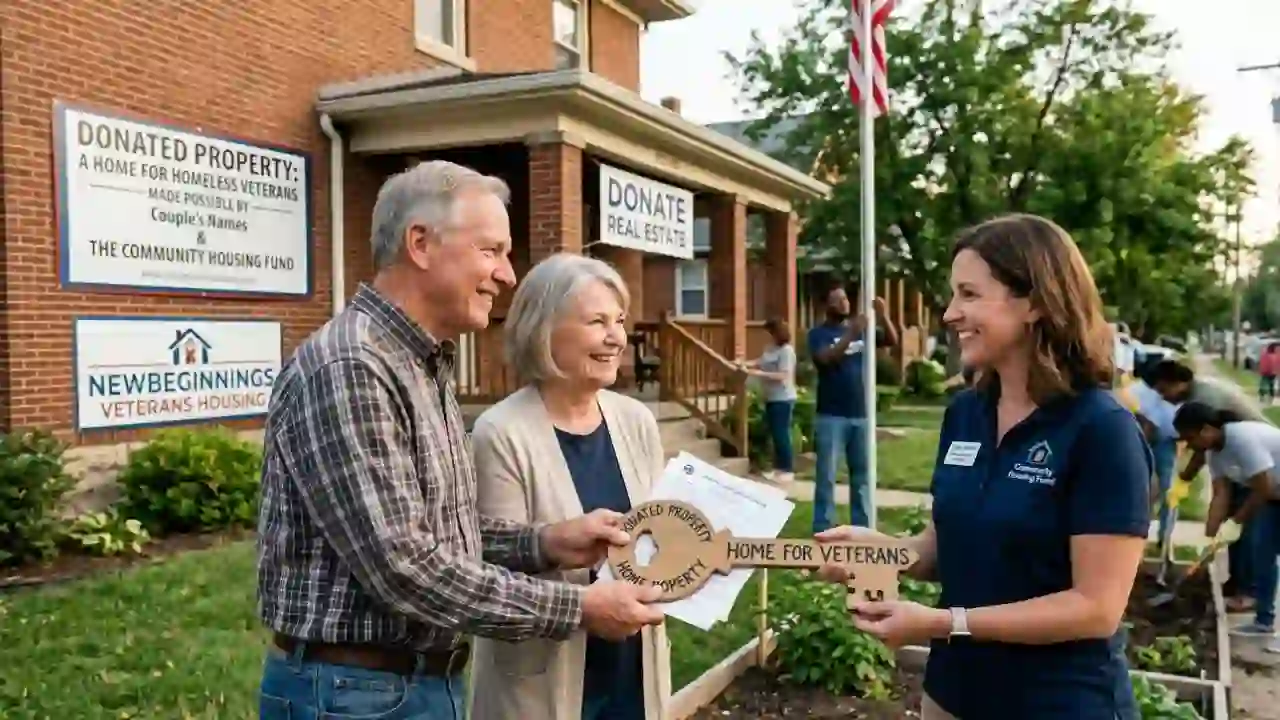
donate real estate
Donating property to a qualified nonprofit can eliminate capital gains tax, generate a significant income tax deduction, and put unwanted real estate to meaningful use. Here’s everything you need to know before you start.
Why donate real estate instead of selling it?
Selling sounds simple — list it, close, collect a check. But if your property has appreciated over the years, a sale can trigger a serious tax bill. Donating real estate to charity sidesteps that cost entirely and gives you a deduction on top of it.
For many property owners, the combined financial benefit of avoided capital gains and an income tax deduction exceeds what they would have netted from a sale. That’s before you account for the fact that someone else handles the property management, the listing, and the closing.
Real donor story“Margaret inherited a beach cottage she had no use for. Selling would have cost her tens of thousands in capital gains tax. Instead, she donated it to a housing nonprofit, avoided the tax entirely, and claimed a fair market value deduction that offset her income tax for three years. She told me the property finally found its true purpose.”
— Financial advisor account, 2024
The tax benefits of donating real estate to charity
Here’s where the numbers get compelling. Suppose you bought a property for $80,000 and it’s now worth $300,000. If you sell, you owe capital gains tax on $220,000 of profit — potentially $33,000 to $44,000 at the federal level, more in high-tax states.
If you donate that same property to a qualified 501(c)(3) charity instead:
- You avoid capital gains tax entirely
- You receive a charitable deduction equal to the full fair market value ($300,000 in this example)
- Unused deduction carries forward for up to five additional tax years
IRS rule to know: Charitable deductions for donated real estate are capped at 30% of your adjusted gross income (AGI) in the year of the gift. Any remaining deduction rolls over for up to five years.
What about donating depreciated real estate?
If your property has lost value since you bought it, your deduction is limited to its current fair market value. If the property was used in a trade or business and you claimed depreciation over the years, the IRS may require you to recognise some of that depreciation as ordinary income — a process called depreciation recapture.
This doesn’t donate a bad idea. It does make a CPA essential before you sign anything.
What types of real estate can you donate?
- Primary residences and vacation homes
- Vacant or undeveloped land
- Commercial property and office buildings
- Rental property and multi-family units
- Inherited property you don’t want to manage or sell
- Farmland and rural acreage
How to donate real estate to charity: step by step
-
Find a qualified charity that accepts real estate. The organisation must be a recognised 501(c)(3) nonprofit. Not every charity has the resources to handle a property donation — confirm their capacity upfront before going further.
-
Run a title search. Outstanding liens, mortgages, or unresolved legal disputes can block a donation. A clean title is a prerequisite for any transfer.
-
Get an independent, qualified appraisal. For any non-cash charitable contribution over $5,000, the IRS requires a qualified appraisal. It must be conducted no more than 60 days before the donation and no later than the due date of your tax return. This appraisal establishes the deduction you can claim.
-
Transfer the deed. Work with a real estate attorney to prepare and record the deed transferring ownership. Do not attempt this step without legal guidance.
-
File IRS Form 8283. Attach Form 8283 (Noncash Charitable Contributions) to your tax return. For donations valued above $500,000, you must also attach the full appraisal report. The charity must sign the form.
-
Claim your deduction on Schedule A. Keep all documentation: the appraisal, the deed transfer, and the charity’s written acknowledgement of the gift. You’ll need all of it to support your deduction.
“David owned a small commercial building that had become more trouble than it was worth. He donated it to a local housing nonprofit that converted it into transitional housing for families. The process took about three months. He avoided capital gains tax on $180,000 of appreciation and saved another $28,000 in income taxes. Six months later, he drove past and saw families moving in.”
— Property investor, 2024
Which charities accept real estate donations?
Not all nonprofits have the staff or experience to manage a property transfer. The organisations are well-established in this space:
For a more local option, your community foundation is a good starting point. They typically have relationships with multiple nonprofits and can help match your property type to the right organisation.
Can you donate real estate to a donor-advised fund?
Yes — and this is a particularly flexible strategy. When you contribute property to a donor-advised fund (DAF), you receive an immediate deduction at fair market value, avoid capital gains tax on the appreciation, and can recommend grants to your chosen charities over time at your own pace.
The DAF handles the eventual sale of the property. This structure works well for donors who want to support multiple organisations or haven’t decided on a specific cause yet.
Comparison: sell vs. donate vs. donor-advised fund
| Scenario | Capital gains tax | Tax deduction | Best for |
|---|---|---|---|
| Selling appreciated property | Yes, up to 20% federal | None | When you need cash proceeds |
| Donating appreciated property | Avoided entirely | Full fair market value | High-appreciation, single charity |
| Donating via a donor-advised fund | Avoided entirely | Full fair market value | Multi-charity or undecided giving |
| Donating inherited property | Minimal (stepped-up basis) | Full fair market value | Heirs who don’t want the property |
| Donating depreciated property | May trigger recapture | Current FMV only | Limited; requires CPA review first |
Special situations worth knowing about
Donating inherited property
Inherited property receives a stepped-up basis — your cost basis resets to the property’s fair market value on the date of the original owner’s death. If you donate shortly after inheriting, capital gains exposure is minimal because the basis is already close to the current value. You still receive the full fair market value deduction. For heirs who don’t want the property, this is often the cleanest outcome possible.
Donating a rental property
You can donate a rental property to a nonprofit, but depreciation recapture may apply. If you’ve claimed depreciation over the years, the IRS will tax a portion of that as ordinary income. Many charities experienced with real estate donations know how to manage tenant notifications and existing lease agreements — just be transparent with them from the start.
Donating commercial property
Commercial donations follow the same general process but often involve environmental assessments, zoning considerations, and more complex lease structures. Not every charity can handle commercial gifts — you may need a larger national organisation or a specialised intermediary. That said, community development nonprofits, arts organisations, and educational institutions are increasingly open to commercial real estate, particularly in urban markets.
Is a “donation of property to a family member” the same thing?
No. Transferring property to a child, sibling, or spouse is a gift — not a charitable donation. It falls under gift tax rules, not charitable contribution rules, and produces no income tax deduction. If the gift exceeds the annual exclusion ($18,000 per recipient in 2024), you may need to file a gift tax return. Talk to an estate planning attorney if wealth transfer within the family is your goal.
Key IRS rules for donating real estate
- The receiving organization must be a qualified 501(c)(3) — foreign charities and individuals do not qualify
- A qualified appraisal is required for donations over $5,000
- Deduction is capped at 30% of AGI for appreciated capital gain property donated to a public charity
- Unused deduction carries forward for up to five years
- Form 8283 must be attached to your return; donations over $500,000 require the full appraisal
- The charity must provide a written acknowledgement before you file
- If the charity sells the property within three years, they must file Form 8282 and send you a copy — this is how the IRS verifies the appraisal was accurate
Frequently asked questions
Can I donate a house that still has a mortgage?
It depends. An outstanding mortgage complicates any donation because the charity would be taking on a liability. Some organisations will work through it with you; others won’t. Discuss this upfront and work closely with a real estate attorney before proceeding.
How long does the donation process take?
Typically, two to four months from initial contact to completed deed transfer, assuming the title is clean and the appraisal goes smoothly. More complex properties (commercial, encumbered) can take longer.
Do I need a lawyer to donate real estate?
Yes — for the deed transfer step, you should work with a licensed real estate attorney. A CPA is also strongly recommended to ensure your deduction is documented correctly and to flag any depreciation recapture issues.
What types of property will most charities not accept?
Properties with environmental contamination, major structural problems, significant unpaid liens, or active legal disputes are often declined. A reputable charity will conduct its own due diligence before accepting any gift.
What is the maximum tax deduction I can claim?
The deduction equals the fair market value of the property as established by a qualified appraisal — up to 30% of your AGI in the year of the donation. Any remaining deduction rolls forward for up to five additional years.
Ready to explore a real estate donation? Start by identifying a qualified 501(c)(3) organisation that accepts property, commission an independent appraisal, and bring in a CPA and real estate attorney before signing anything. The property you no longer need could become something remarkable for someone else — and a meaningful financial benefit for you.
About the Author




1 thought on “How to Donate Real Estate to Charity and Save Thousands in Taxes”