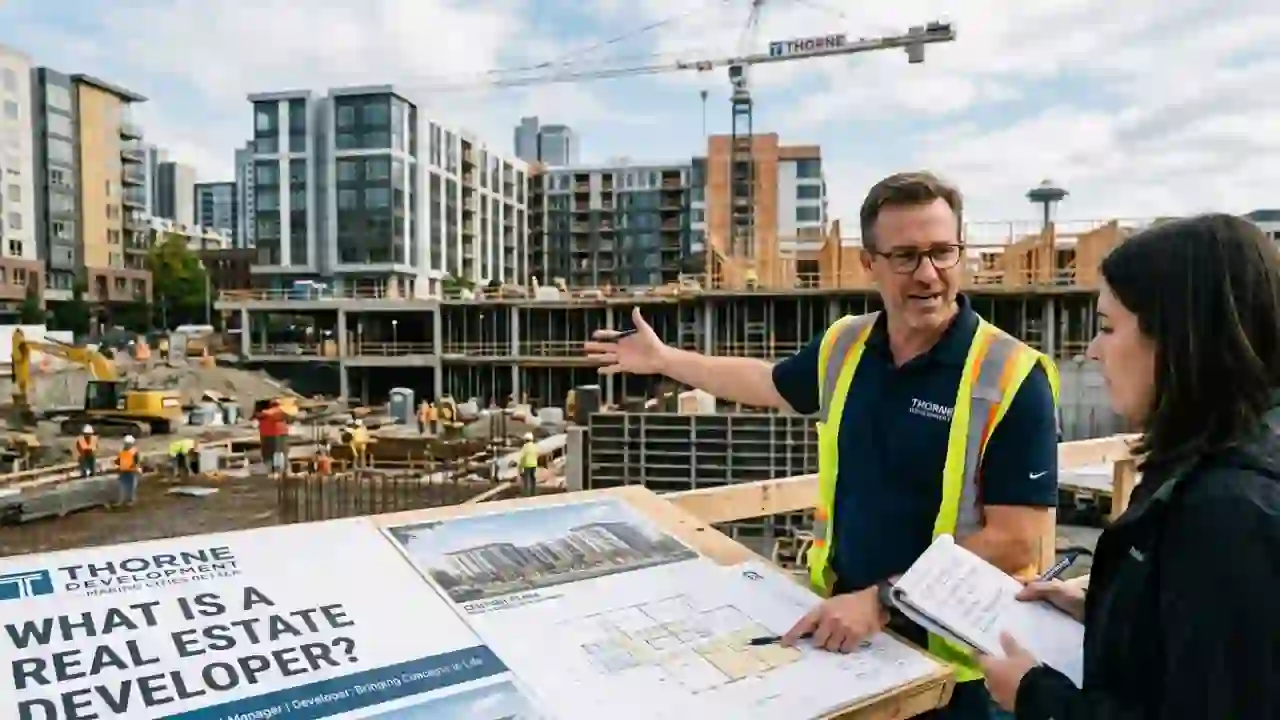
what is a real estate developer
Ever wondered who transforms empty lots into towering apartment complexes? Or who turns old warehouses into trendy shopping centres?
That’s the work of a real estate developer.
I’ll never forget standing outside a stunning mixed-use development in downtown. Three years earlier, it was just a vacant lot filled with weeds. The developer I met that day had turned his vision into 200 apartments, 15 shops, and a community space that now serves thousands.
That conversation changed everything I thought I knew about real estate.
In this guide, you’ll discover exactly what a real estate developer does, how they earn anywhere from $60,000 to millions per year, and the exact steps to become one—even with zero experience.
What Is a Real Estate Developer? The Simple Truth
A real estate developer is the mastermind who transforms raw land or outdated buildings into profitable properties.
Think of them as the orchestra conductor of construction projects.
They don’t lay bricks or draw blueprints. Instead, they:
- Find promising land opportunities
- Secure millions in funding
- Coordinate teams of professionals
- Navigate complex regulations
- Turn ideas into actual buildings
Key insight: Real estate developers carry all the financial risk—but they also reap the biggest rewards when projects succeed.
What Does a Real Estate Developer Actually Do? (Day-to-Day Reality)
No two days are identical for a real estate developer. But their work follows a proven process that turns empty land into profitable properties.
The 6-Step Development Process Every Developer Follows.
1. Market Research and Opportunity Analysis
Before spending a penny, developers analyse:
- Population growth trends
- Rental demand statistics
- Competition in the area
- Economic indicators
This real estate market feasibility study determines if a project will profit or fail.
2. Land Acquisition and Due Diligence
Once the numbers work, developers negotiate land purchases.
But buying land isn’t simple. They must check for:
- Environmental contamination
- Title issues
- Zoning restrictions
- Access to utilities
One missed problem can kill an entire project.
3. Securing Permits and Zoning Approvals
The zoning and permits approval process can take months—or years.
Developers work with:
- City planners
- Building departments
- Environmental agencies
- Community boards
Patience and persistence are essential here.
4. Arranging Construction Financing
Most developers use multiple funding sources:
- Bank construction loans (60-70%)
- Private investor equity (20-30%)
- Developer’s own capital (10-20%)
This building construction financing mix is called the “capital stack.”
5. Managing Construction and Teams
During construction, developers coordinate:
- Architects and engineers
- General contractors
- Subcontractors
- Project managers
They ensure projects stay on schedule and within budget—where a single week’s delay can cost thousands.
6. Marketing and Exit Strategy
The pre-construction and post-construction phases determine profits.
Developers either:
- Sell completed properties for immediate profit
- Lease units for long-term income
- Refinance and hold for appreciation
Real Estate Developer vs. Builder vs. Agent: Key Differences
Many people confuse these roles. Here’s the truth:
| Professional | Primary Role | Owns Property? | Takes Financial Risk? | Typical Earnings |
|---|---|---|---|---|
| Developer | Creates entire projects | Yes | Yes (all of it) | $200K-$5M+ per project |
| Builder | Physical construction | No | No | $50K-$150K salary |
| Agent | Sells/leases properties | No | No | 2-6% commission |
| Investor | Provides capital | Sometimes | Yes (partial) | 8-20% returns |
Bottom line: Developers orchestrate everything. Builders construct. Agents sell. Investors fund.
Types of Real Estate Developers (Which Path Is Right for You?)
Residential Developers
Build homes, apartments, and condos.
- Pros: Easier entry, smaller projects, faster sales
- Cons: Lower profit margins, more competition
- Best for: Beginners and small-scale operators
Commercial Developers
Create offices, retail centres, and hotels.
- Pros: Higher profits, longer leases, institutional buyers
- Cons: Requires more capital, longer timelines
- Best for: Experienced developers with strong networks
Mixed-Use Developers
Combine residential and commercial in one project.
- Pros: Diversified income, urban planning advantages
- Cons: Complex approvals, higher costs
- Best for: Developers in urban markets
Industrial Developers
Build warehouses, logistics centres, and data centres.
- Pros: E-commerce boom, long-term leases
- Cons: Location-dependent, specialised knowledge needed
- Best for: Developers near transportation hubs
How Do Real Estate Developers Make Money? (5 Revenue Streams)
Understanding developer income streams reveals why they accept such high risks.
1. Development Profit Margins (15-30%)
Buy land for $1 million. Built for $4 million. Sell for $7 million.
Profit: $2 million
2. Ongoing Rental Income
Keep the property. Collect rent forever.
A 200-unit apartment building can generate $300,000+ monthly.
3. Development Fees (3-5% of project cost)
Manage projects for investors. Earn fees regardless of profit.
On a $10 million project: $300,000-$500,000 in fees.
4. Equity Appreciation
Hold properties long-term. Benefit from market appreciation.
Properties often double in value over 7-10 years.
5. Syndication Profits (20% carried interest)
Raise money from investors. Keep 20% of profits above target returns.
This is how developers build wealth without using their own money.
Real Estate Developer Salary: What to Really Expect
What is a real estate developer’s salary? It depends entirely on your path.
Employed Developers (Working for Companies)
- Entry-level: $60,000-$80,000
- Mid-level: $90,000-$120,000
- Senior: $150,000-$300,000+
- Plus: Bonuses and profit sharing
Independent Developers (Self-Employed)
- Small projects: $50,000-$200,000 per project
- Medium projects: $200,000-$1 million per project
- Large projects: $1 million-$10 million+ per project
Reality check: First-year developers often earn nothing while learning. Year five can bring life-changing profits.
Key Responsibilities of a Real Estate Developer
Daily responsibilities span multiple disciplines:
Financial Management
- Create pro formas and financial models
- Negotiate loan terms and equity deals
- Manage project budgets and cash flow
Project Leadership
- Hire and coordinate professional teams
- Make critical design and construction decisions
- Solve problems that threaten the timeline or the budget
Regulatory Navigation
- Secure zoning changes and variances
- Obtain building permits and approvals
- Ensure code compliance throughout
Market Strategy
- Position projects for target demographics
- Set pricing and lease rates
- Create marketing and sales campaigns
How to Become a Real Estate Developer (Step-by-Step Guide)
Step 1: Build Your Foundation (3-6 months)
- Read 10 essential real estate development books
- Take online courses in finance and construction
- Study successful projects in your market
- Learn basic financial modelling
Step 2: Gain Relevant Experience (1-2 years)
Work in one of these fields first:
- Construction management
- Commercial real estate brokerage
- Real estate investment firms
- Architecture or engineering firms
Pro tip: Choose roles that expose you to entire projects, not just one piece.
Step 3: Develop Your Network (Ongoing)
Essential relationships include:
- Commercial lenders and private investors
- Architects and engineers
- General contractors
- Real estate attorneys
- City planning officials
Join local real estate investment clubs. Attend industry conferences. Build relationships before you need them.
Step 4: Start Small and Smart (Year 2-3)
First projects that work:
- House flips with value-add potential
- Small multifamily (2-4 units)
- Commercial renovation projects
- Joint ventures with experienced developers
Warning: Your first project will teach you more than any course—choose one you can afford to make mistakes on.
Step 5: Scale Strategically (Year 3+)
- Reinvest profits into larger projects
- Build a track record for lender confidence
- Develop a niche expertise
- Consider forming a development company
Educational Paths: Degrees, Courses, and Certifications
Valuable Degrees
- Real Estate Development (Most direct path)
- Finance or Business (Understanding money)
- Architecture or Engineering (Technical knowledge)
- Urban Planning (Regulatory expertise)
Professional Certifications
- CCIM (Commercial Investment)
- LEED AP (Sustainable Development)
- PMP (Project Management)
Online Learning Options
- MIT Real Estate Development Course
- Cornell Real Estate Certificate
- ULI Real Estate School
Note: No real estate developer license exists in most markets, but some activities may require broker or contractor licenses.
Common Myths About Real Estate Development (Debunked)
Myth 1: You need millions to start
Truth: Many developers started with $50,000-$100,000 and creative financing
Myth 2: You must have a construction background
Truth: Only 30% of developers come from construction
Myth 3: It’s too risky for normal people
Truth: Proper due diligence and conservative underwriting minimise risk
Myth 4: The market is too saturated
Truth: Population growth creates constant demand for new development
Frequently Asked Questions
Do real estate developers need special licenses?
Most markets don’t require a specific developer license. However, you may need broker or contractor licenses for certain activities. Check your local regulations.
How long do development projects take?
- Small residential: 12-18 months
- Medium commercial: 2-3 years
- Large mixed-use: 4-7 years
The approval process alone can take 6-24 months.
What’s the minimum capital needed to start?
You can start with $50,000-$100,000 for small projects using creative financing. Partner with investors or start with renovation projects to build capital.
Is the industry recession-proof?
No. Real estate is cyclical. Smart developers prepare for downturns by maintaining cash reserves and avoiding excessive leverage.
Can you be a part-time developer?
Yes, many successful developers started part-time while maintaining other income. Small projects and partnerships make this possible.
The Bottom Line: Your Path Forward
Real estate developers transform communities while building wealth. They navigate complex challenges, take calculated risks, and create lasting value.
The path isn’t easy. But it’s accessible to anyone willing to learn, network, and start small.
Your next steps:
- Choose your initial market focus
- Start building your network this week
- Analyse 10 real projects in your area
- Find a mentor or partner
- Take action on your first small project
Remember: Every skyscraper started with someone who had a vision and the courage to pursue it.
The question isn’t whether you can become a real estate developer. It’s whether you’re ready to start.
About the Author






1 thought on “What Is a Real Estate Developer? Roles, Skills & Guide”