Kangaroo Insurance Claim
Kangaroo insurance claim: complete step-by-step guide
Everything Australian drivers need to know — from the roadside to claim settlement.
Are you covered? Understanding your policy type
Not all car insurance covers a kangaroo strike. Your eligibility depends entirely on your policy type.
Covers animal strike damage to your own vehicle, minus your excess. The right policy for rural and regional drivers.
Only covers claims made against you by others. Your vehicle damage from a kangaroo strike is not included.
The most basic policy available. No cover for your own vehicle, regardless of the cause.
If you drive regularly in areas where kangaroos are present, comprehensive cover is essential — not optional.
Kangaroos are responsible for around 80% of all animal-related vehicle collisions in Australia, according to insurance industry data.
What to do right after hitting a kangaroo
The steps you take at the scene directly affect how smoothly your claim is processed. Here is what to do in order.
- Pull over safely and activate hazard lights. Get off the road if possible. Your safety is the priority.
- Do not approach the kangaroo. An injured kangaroo can kick with serious force. Stay in your vehicle or keep a safe distance.
- Call 000 if other road users are at risk. If the animal is blocking the road, call emergency services. A police report also strengthens your claim.
- Contact a wildlife rescue service NSW: WIRES on 1300 094 737. Victoria: Wildlife Victoria on 03 8400 7300. Most states have a dedicated line. Log the reference number.
- Photograph everything. Take clear photos of your vehicle damage, the animal if visible, the road surface, skid marks, and nearby signage. These images are your primary evidence.
- Record the key details. Note the exact time, location, road conditions, visibility, and the direction you were travelling. More detail means fewer delays later.
- Do not drive an unsafe vehicle. If you see fluid leaks, misaligned wheels, or structural damage, call roadside assistance. Do not drive the car.
Save your insurer’s claims phone number before you ever need it. Searching for it on a dark roadside at 11 pm is not the experience you want.
How to file a kangaroo insurance claim: step by step
Step 1: Contact your insurer promptly
Most insurers require you to report an incident within 24 to 72 hours. Call using the claims number on your policy card, or start a kangaroo insurance claim online through your insurer’s portal. Online submission is usually faster and lets you upload photos directly.
Step 2: Provide your incident details
Have these ready before you call or log in: your policy number, the time, date and location of the incident, a clear description of what happened, the extent of the damage, and whether police or wildlife rescue were contacted.
Step 3: Complete the claim form
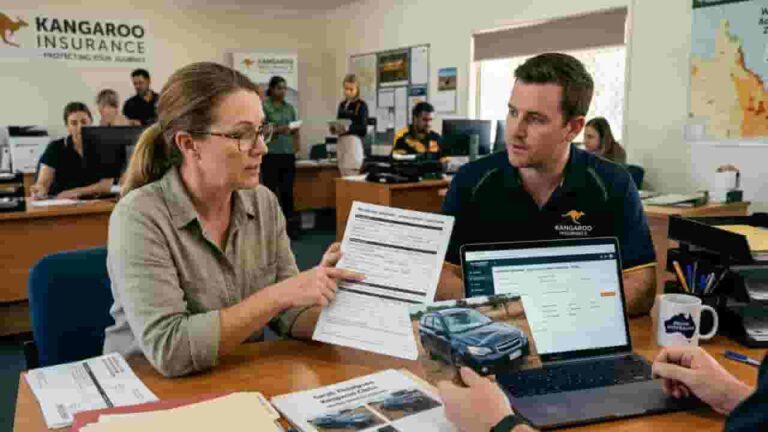
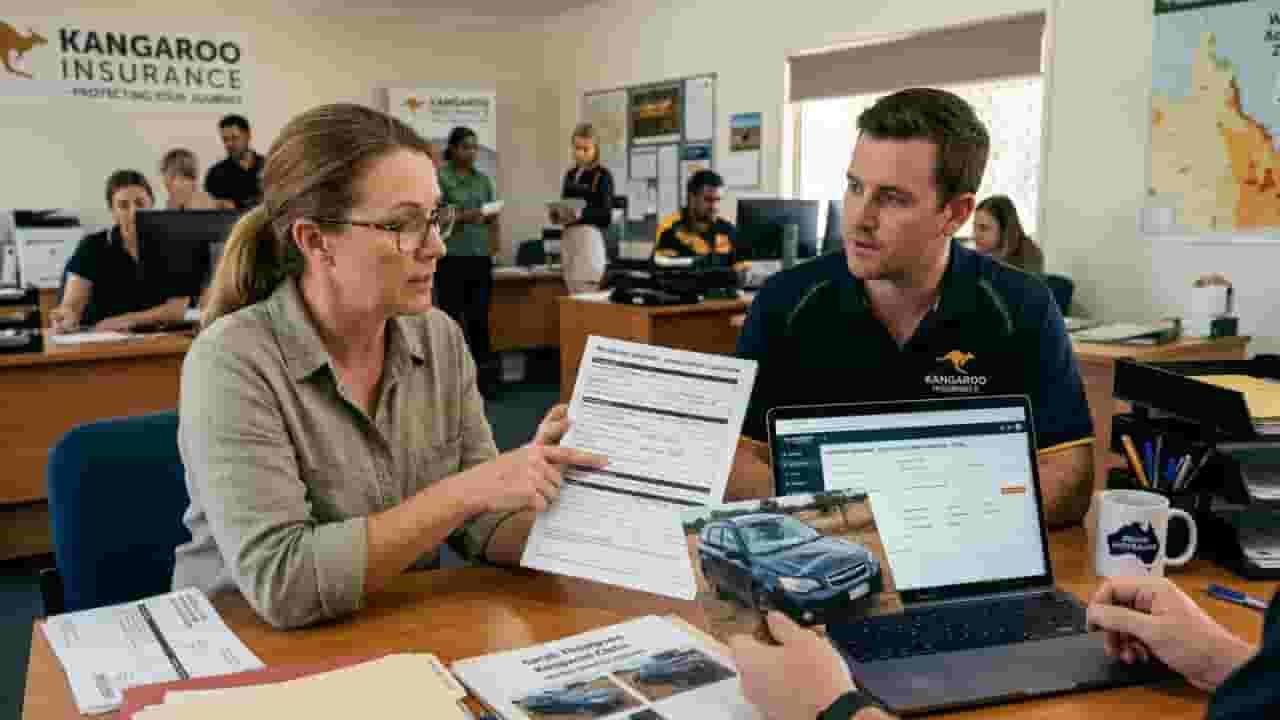
Your insurer will ask you to fill out a kangaroo insurance claim form. Many providers offer a downloadable PDF version or an online form within their portal. Fill it out carefully — incomplete forms are the most common cause of processing delays.
Step 4: vehicle assessment
Once your claim is lodged, the insurer arranges an assessor to inspect your vehicle. This may happen at an approved repairer, an assessment centre, or at the scene if the vehicle cannot be driven. The assessor determines the extent of the damage and whether it is repairable or a total loss.
Step 5: repairs or settlement
If repairable, your insurer directs you to an approved repairer. If it is a total loss, they settle based on either the agreed value or market value stated in your policy. Your excess is deducted from the payout either way.
How to check your claim status
After lodging your claim, you can track its progress through several channels.
- Online portal — most major insurers have a claims dashboard for real-time status updates.
- Mobile app — some insurers send push notifications as each stage is complete.d
- Phone — call with your claim reference number to speak with a consultant directly
- Email — automated updates are sent at key milestones by most insurers
Simple claims with clear evidence are typically approved within two to five business days. Write-offs and more complex claims can take two to four weeks. Submitting complete documentation upfront is the single best way to avoid delays.
Documents you need for a kangaroo insurance claim
- Insurance policy number
- Driver’s licence details
- Photos of vehicle damage
- Photos of the scene or animal
- Police report number (if applicable)
- Wildlife rescue call reference
- Date, time, and exact location
- Witness details (if available)
- Repair quotes if using own repairer
Will your no-claim bonus be affected?
In most cases, no. Australian insurers generally classify kangaroo strikes as not-at-fault incidents. Your no-claim bonus (NCB) or no-claim discount (NCD) is typically protected because the collision was not caused by negligence.
However, you will almost always still pay your excess — the agreed amount you contribute regardless of fault. This is deducted from your repair costs or settlement. Read your Product Disclosure Statement (PDS) carefully, and if you are unsure, ask your insurer directly before lodging.
What if you swerved to avoid a kangaroo and missed it?
This is more common than most people realise. You swerve, hit a fence or tree, or roll the vehicle — but never actually contact the animal. In this situation, the claim is typically classified as a single vehicle accident rather than an animal strike.
Comprehensive insurance still covers single-vehicle accidents in most cases. The key difference is that at-fault determination may apply differently under your policy, which could affect your NCB. When describing the incident, be specific: state that you swerved to avoid a kangaroo on the road in front of you. Accuracy here protects you.
What happens if your car is a write-off?
When repair costs exceed a percentage of your vehicle’s value, the insurer declares it a total loss. Here is what follows.
- The insurer formally notifies you of the total loss determination
- Settlement is calculated based on the agreed value or the market value, depending on your policy
- Your excess is deducted from the settlement amount
- If you have hired a car cover, a temporary vehicle may be available while the claim finalises
- Once you accept the settlement, you sign over the vehicle title,e and the insurer handles the disposal
If you disagree with the insurer’s market value assessment, gather independent valuations and use the insurer’s internal dispute resolution process. If unresolved, escalate to the Australian Financial Complaints Authority (AFCA).
Tips to speed up your claim approval
- Lodge the same day if possible — the sooner you report it, the sooner the process starts
- Submit clear photos immediately — multiple angles, good lighting, close-ups of all damage.
- Be precise about time and location — insurers may cross-reference weather and road conditions
- Use the online portal — digital claims are typically processed faster than phone or manual submission. ons
- Complete the form in full — missing fields are the most common reason for delays
- Respond to insurer queries the same day — every delay from your end adds time to the process
- Ask about hire car cover upfront — do not assume it is included in your .policy
Frequently asked questions
Final word
A kangaroo insurance claim is one of the most common vehicle claims in regional Australia — and one of the most manageable, provided you have the right cover and know the steps. Comprehensive insurance is non-negotiable if you drive in kangaroo country. Documentation at the scene is everything. And lodging your claim quickly, with complete information, is the single best way to keep the process short.
And next time you are on a country road at dusk — slow down a little. The roos are worth it.
link:- short term disability maternity leave insurance: What It Pays & How to Get Covered
About the Author