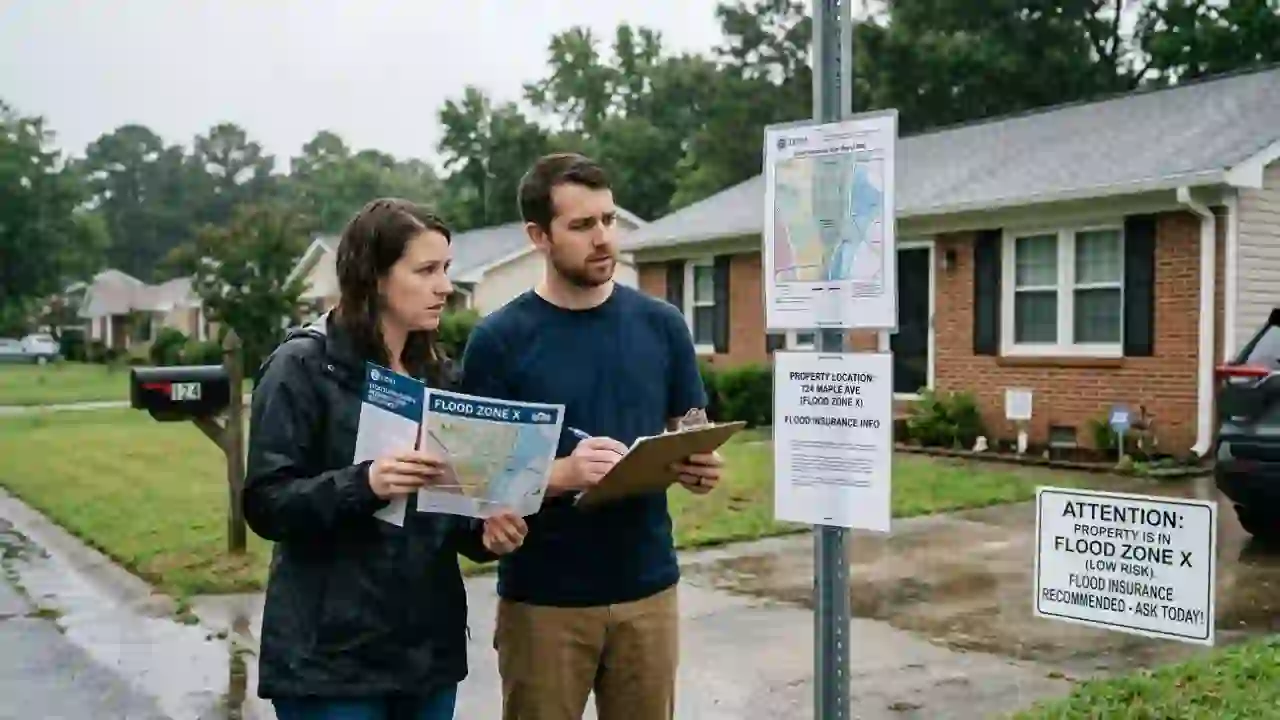
flood zone x flood insurance
If your property is in Flood Zone X, you’ve probably heard something like this: “Don’t worry — you’re in a low-risk zone. Flood insurance isn’t required.”
That’s technically true. But it may be the most expensive advice you’ll ever take.
A neighbour of mine found that out the hard way. His Zone X home took on water during a heavy storm when the local drainage system backed up. No flood insurance. Over $40,000 in damage. Zero warning.
This guide covers everything you need to know — what Zone X actually means, whether you’re legally required to carry insurance, what it costs, and why buying a policy anyway might be one of the smartest financial moves you make this year.
What Is Flood Zone X on a FEMA Map?
FEMA assigns every property in the U.S. a flood zone designation on what’s called a Flood Insurance Rate Map (FIRM). These designations help lenders, insurers, and homeowners understand how likely a property is to flood.
Flood Zone X = Low to Moderate Risk.
It sits outside the 100-year floodplain, meaning there’s less than a 1% annual chance of flooding. But Zone X isn’t a single category — it has two important sub-designations.
Shaded Zone X (Moderate Risk)
Previously labelledZone B, shaded Zone X carries a 0.2% annual flood chance — roughly a 1-in-500 risk each year. Over a 30-year mortgage, that adds up to about a 6% cumulative chance of experiencing a flood. That’s not insignificant.
Unshaded Zone X (Minimal Risk)
Previously labelledZone C, unshaded Zone X represents the lowest FEMA risk category. These properties sit outside both the 100-year and 500-year floodplains.
Pro tip: Check which version applies to your address using FEMA’s Flood Map Service Centre. The distinction can affect both your risk level and your insurance premiums.
Is Flood Insurance Required in Zone X?
No, not for most homeowners.
Federal law only mandates flood insurance for properties in high-risk zones (Zone A, AE, V, VE) when the mortgage is federally backed. If your home is in Zone X, your lender almost certainly won’t require it.
That said, there are exceptions:
- Private lenders sometimes set stricter internal policies and require coverage regardless of the zone
- Homeowner associations may mandate flood insurance for all properties
- Local municipalities in flood-prone areas occasionally require coverage even in low-risk zones
But for the vast majority of Zone X homeowners with a standard mortgage? Nobody will force you to buy it.
The real question is whether you should — and that’s where things get interesting.
Is Flood Zone X Safe? Good or Bad?
Zone X is better than being in Zone A or Zone V. There’s no question about that: lower risk, cheaper premiums, no lender mandate.
But here’s the number that should give you pause:
More than 20% of all NFIP flood insurance claims come from properties outside high-risk flood zones.
That includes Zone X.
Flooding doesn’t check your designation before it enters your living room. New construction upstream, ageing storm drains, record rainfall, and shifting climate patterns can all cause flooding in areas that FEMA maps mark as “low risk.”
A Texas family I spoke with had their Zone X home flood without warning. They received roughly $5,000 in FEMA disaster assistance — paid back as a loan — on $60,000 in damage. They had no flood insurance because an agent told them they didn’t need it.
Zone X is a favourable designation. It is not a guarantee.
5 Reasons to Buy Flood Zone X Insurance Anyway
1. Flooding Doesn’t Follow Zone Lines
FEMA maps are based on historical data modelling — not crystal balls. Development patterns, extreme weather events, and climate shifts regularly produce flooding in “safe” zones that the models didn’t anticipate.
2. Your Homeowners Insurance Won’t Cover It
This is the single biggest misconception in home insurance. Standhomeowners ‘cies do not cover flood damage. Not an inch of it. You need a separate flood policy, full stop.
3. The Cost Is Surprisingly Low
Zone X homeowners typically qualify for preferred risk flood policies through the NFIP. Annual premiums often run just $400–$650 — roughly the cost of a streaming service and a gym membership combined.
4. The Potential Loss Is Enormous
Just one inch of floodwater can cause $25,000 or more in damage. The average NFIP claim payout exceeds $50,000. A $500/year policy against a five-figure repair bill is straightforward math.
5. Zone Changes Can Happen
FEMA updates flood maps regularly. If your property gets reclassified into a high-risk zone, flood insurance becomes mandatory — and far more expensive. If you already have a policy in place, you may qualify for grandfathered rates, locking in your current lower premium.
How Much Does Flood Zone X Insurance Cost?
Zone X is where flood insurance is actually affordable. Here’s what most homeowners pay through the NFIP in 2025:
| Coverage Type | Estimated Annual Cost |
|---|---|
| Building only (up to $250,000) | $325 – $450 |
| Building + Contents | $450 – $650 |
| Contents only (up to $100,000) | $150 – $250 |
Your exact premium depends on factors like:
- Age and size of your home
- Foundation type (slab, crawlspace, basement)
- Elevation relative to base flood elevation
- Your chosen deductible
- Distance to a water source
Under FEMA’s Risk Rating 2.0, introduced in 2021, pricing became more individualised. Many Zone X properties actually saw premiums drop under the new model because it rewards low-risk characteristics more precisely.
Private flood insurers can also be competitive — sometimes cheaper — and may offer extras like temporary living expense coverage that NFIP policies don’t include.
Flood Zone X vs. Zone AE: Key Differences
If you’re comparing properties or trying to understand your risk, here’s how Zone X stacks up against Zone AE — the most common high-risk designation.
| Factor | Zone X | Zone AE |
|---|---|---|
| Risk Level | Low to Moderate | High |
| Annual Flood Chance | Less than 1% | 1% or greater |
| Insurance Required? | No | Yes (federally backed mortgages) |
| Typical Annual Premium | $400 – $650 | $1,200 – $3,500+ |
| FEMA Classification | Non-Special Flood Hazard Area | Special Flood Hazard Area |
The premium difference alone — often $800 to $3,000 per year — is a major reason Zone X properties are more financially attractive, especially in coastal and riverine markets.
Flood Zone X in California and Florida
California
Floods rarely come to mind when people think of California — but they should. Recent atmospheric river storms caused historic flooding across regions technically classified as low-risk. Burn scar areas, communities near ageing levees, and hillside neighbourhoods are particularly vulnerable.
Flood Zone X flood insurance in California is increasingly worth considering as the state’s weather patterns become less predictable. Preferred risk policies offer meaningful protection at a fraction of the cost of post-disaster recovery.
Florida
Florida accounts for more NFIP policies than any other state. While coastal properties in high-risk zones get most of the attention, a large share of Florida homes sit in Zone X — and face real exposure.
During Hurricane Ian in 2022, several Zone neighbourhoods in Central Florida took on floodwater. Homeowners with flood insurance recovered. Those without are still managing the financial fallout.
If you live in Florida and you’re in Zone X, flood insurance isn’t just recommended — it’s arguably essential.
How to Buy Flood Insurance in Zone X
The process is simpler than most people expect.
Step 1 — Confirm your flood zone. Visit FEMA’s Flood Map Service Centre and enter your address. Verify whether you’re in shaded or unshaded Zone X.
Step 2 — Gather your property details. You’ll need your home’s year of construction, square footage, foundation type, number of floors, and whether you have a basement or enclosed space.
Step 3 — Get NFIP quotes. Any licensed insurance agent participating in the National Flood Insurance Program can write you a policy. Coverage and pricing are standardised across all NFIP agents.
Step 4 — Compare private market options. Private flood insurers have expanded significantly. They may offer lower premiums, faster claims processing, higher coverage limits, or additional benefits not available through NFIP.
Step 5 — Purchase and confirm your effective date. NFIP policies have a 30-day waiting period. There are exceptions — such as when purchasing at closing or following a flood map amendment — but don’t wait until a storm is approaching.
What Happens If Your Zone Changes?
FEMA revises flood maps based on new data, development, and climate studies. If your Zone X property gets reclassified to Zone AE or another high-risk designation:
- Flood insurance becomes mandatory if you have a federally backed mortgage
- Premiums jump — often by $800 to $3,000 or more per year
- If you already have a policy, you may qualify for grandfathered rates
This grandfathering benefit is one of the most overlooked reasons to buy Zone X flood insurance before you’re required to. It functions both as financial protection today and a hedge against higher costs tomorrow.
Frequently Asked Questions
Do I need flood insurance in Zone X?
Federally backed lenders do not require it. But financial advisors and flood risk experts widely recommend it. More than 20% of NFIP claims come from outside high-risk zones. A preferred risk policy in Zone X costs a few hundred dollars per year and can protect against tens of thousands of dollars in damage.
How much does flood insurance cost in Zone X?
Most Zone X homeowners pay between $400 and $650 per year for building and contents coverage through the NFIP. Private insurers may offer lower rates depending on your property’s characteristics.
Is Zone X considered high-risk?
No. Zone X is a low-to-moderate risk designation and falls outside FEMA’s Special Flood Hazard Area. But low risk is not the same as no risk — floods do occur in Zone X.
What’s the difference between shaded and unshaded Zone X?
Shaded Zone X (formerly Zone B) carries a 0.2% annual flood chance and represents moderate risk. Unshaded Zone X (formerly Zone C) carries an even lower chance and represents minimal risk. Both fall outside the 100-year floodplain.
Can I get cheap flood insurance in Zone X?
Yes. Zone X typically qualifies for preferred risk flood policies, which are among the most affordable available through the NFIP. Private insurers may also offer competitive rates.
Bottom Line
Flood Zone X flood insurance isn’t legally required for most homeowners. But “not required” and “not necessary” are two very different things.
For a few hundred dollars a year, you get protection against tens of thousands in potential damage, a financial hedge against future zone reclassification, and coverage your homeowners policy will never provide.
Check your FEMA flood map. Talk to an agent who knows both the NFIP and private market options. Get a quote — it takes 20 minutes.
Don’t wait for the flood to wash over you and wish you had the policy.
About the Author







1 thought on “ Flood Zone X Flood Insurance: Do You Really Need It in 2025?”