
Let’s talk about the elephant in the room.
Every Indian grows up with one financial dream: “Ek din Mumbai mein apna ghar hoga.” (One day I’ll own a home in Mumbai).
It’s an emotional goal. But emotions make for terrible investments.
If you look at the price tags in Mumbai today—₹2 Crores for a matchbox apartment in Andheri, ₹5 Crores for a view of a slum in Worli—you have to ask yourself: Does this actually make sense?
Are you buying an asset, or are you buying a liability that will drain your bank account for the next 20 years?
I’ve spent years analysing this crazy market. I’ve seen people make fortunes, and I’ve seen people get stuck with “dead assets” they can’t sell.
As we approach 2026, the game has changed. The old rules of “Just buy and hold” don’t work anymore.
In this guide, I’m going to give you the unfiltered truth. No broker talk. No sugar-coating. Just the cold, hard numbers about putting your money into the City of Dreams.
The “Math” Problem No One Talks About
Let’s do a quick calculation that most brokers hate.
Suppose you buy a flat for ₹2 Crores. You take a loan.
- EMI: Approximately ₹1.5 Lakhs per month.
- Maintenance: ₹10,000 per month.
- Total Outflow: ₹1.6 Lakhs/month.
Now, let’s say you rent it out. What’s the rent for a ₹2 Cr flat in Mumbai? Maybe ₹50,000 if you are lucky.
The Result: You are paying ₹1.6 Lakhs to earn ₹50,000.
You are losing ₹1.1 Lakhs every single month from your pocket.
So, if you are looking for “Passive Income,” stop right now. Mumbai residential real estate is terrible for cash flow. It’s a cash drain.
The only reason—and I mean the only reason—to invest here is if you believe the price of that flat will jump to ₹4 Crores in 5 years.
So, Why Do People Still Buy? (The Secret Sauce)
If the rent is so bad, why is Mumbai still the hottest market in India?
Two words: Supply and Demand.
Mumbai is an island. We can’t build more land. We can only build up.
Unlike Delhi or Bangalore, which can keep expanding into the farmlands, Mumbai is trapped by the sea. This scarcity creates a safety net. Even in the worst recession, prices in Mumbai rarely crash. They might freeze, but they don’t drop 30% like they do in Noida or Gurgaon.
The “Infrastructure” Gamble:
Right now, the city is undergoing surgery.
The Metro network is finally connecting the dots. The Trans-Harbour Link (MTHL) has connected the island to the mainland. The Coastal Road is speeding up traffic.
These projects are the key. If you buy in a place that is about to get a Metro station, you win. If you buy in a place that is already saturated (like Bandra), your growth is capped.
The New Goldmines: Where to Look in 2026
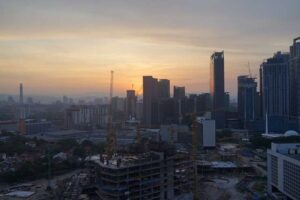
If you have money to deploy, don’t look at the postcards. Look at the dirt. Look where the cranes are.
1. The “Third Mumbai” (Navi Mumbai Extension)
Everyone knows Vashi and Belapur. That ship has sailed.
The new gold is Ulwe, Dronagiri, and Panvel.
Why? The new Airport.
History tells us that real estate near international airports always explodes. It happened in Bangalore (Devanahalli), it happened in Hyderabad (Devanahalli), and it will happen here. Prices are still under ₹1 Crore in many spots. This is a long-term play (5-7 years), but the upside is massive.
2. The “Upper” Suburbs (Beyond Borivali)
Places like Mira Road and Dahisar used to be jokes. “Oh, you live that far?”
Not anymore. The Metro has killed the distance.
You can get a luxury township lifestyle—swimming pool, gym, garden—for ₹80 Lakhs here. In Andheri, that lifestyle costs ₹4 Crores. As the middle class gets squeezed out of the city, this is where they will move. Demand equals appreciation.
3. The “Boutique” Office
Here is a contrarian idea: Don’t buy a house. Buy a small office.
A 300 sq. ft. office in a business hub (like Malad Mindspace or Vashi) costs less than a 1BHK apartment.
But the rent? Commercial properties yield 6-8%.
Plus, businesses sign 5-year leases. You don’t have to chase tenants every 11 months. If you want income, this is the smarter play.

The Traps: How to Lose Money in Mumbai
I have seen smart people make dumb mistakes here. Don’t be one of them.
Trap #1: The “Pre-Launch” Offer
Builders will show you a brochure. “Pay 10% now, no EMI till possession!”
It sounds great. But in Mumbai, possession delays are legendary. A “3-year project” often takes 7 years. Meanwhile, your money is stuck earning zero interest.
My Rule: Only buy projects that are 80% complete, or Ready-to-Move. Pay a premium for certainty.
Trap #2: The “SRA” Flats
You might see a cheap flat listing. “Only ₹40 Lakhs in Bandra!”
Then you realise it’s an SRA (Slum Rehabilitation Authority) flat.
Stay away. The legal paperwork is a nightmare. You cannot legally transfer the title for 10 years. You are buying a headache, not a home.
Trap #3: Ignoring the “Carpet Area”
Mumbai builders are magicians. They sell you “Super Built-Up Area.”
They say it’s a 1,000 sq ft apartment. You walk in, and it feels like 600 sq ft. Where did the rest go? Into the lobby, the lift, and the flower bed.
Always transact on the RERA Carpet Area. That is the only space you can actually stand on.
The Verdict: Is it a “Buy”?
Scenario A: You want to live in it.
Yes. Buy it.
Living in your own home in Mumbai provides a mental peace that renting can never match. No landlord kicking you out, no rent hikes. The emotional ROI is higher than the financial ROI.
Scenario B: You want to double your money in 3 years.
No.
Go to the stock market. Go to a Tier-2 city like Nagpur or Indore. Mumbai is a slow-moving giant. It builds wealth over decades, not months.
Scenario C: You want safe, long-term wealth preservation.
Yes.
If you have ₹5 Crores and you want to park it somewhere where it won’t disappear, buy a luxury flat in South Mumbai or Bandra. It’s like buying gold. It holds value.
Final Word
Investing in Mumbai isn’t for the faint-hearted. It requires deep pockets and deep patience.
But there is a reason why every billionaire in India owns a home here.
It’s the city that never sleeps, and eventually, the city that always pays back.
Just be smart. Don’t follow the herd. Follow the infrastructure.
And for heaven’s sake, negotiate hard. In 2026, the buyer is king.
FAQ: Questions You Were Too Afraid to Ask
“Is Redevelopment a good bet?”
It’s a lottery. If you buy an old flat and the society goes for redevelopment, you can get a brand new, bigger flat worth double the price. But… I know families stuck in transit camps for 15 years because the builder ran out of money. Only do this if the builder is Top Tier (Tata, Godrej, etc.).
“What about Thane? Is it Mumbai?”
Technically? No. Financially? Yes. Thane has outperformed Mumbai in appreciation over the last 5 years. It has better roads, better malls, and better air. Don’t let the “Mumbai Pin Code” ego stop you from making money in Thane.
“Can I buy a shop instead?”
Yes, but retail is risky. If the economy tanks, shops close. Offices are safer. Warehouses (on the outskirts) are the safest.
Disclaimer: I am a real estate analyst, not a financial advisor. Property markets are local. Always visit the site yourself before signing a cheque.
Links:-