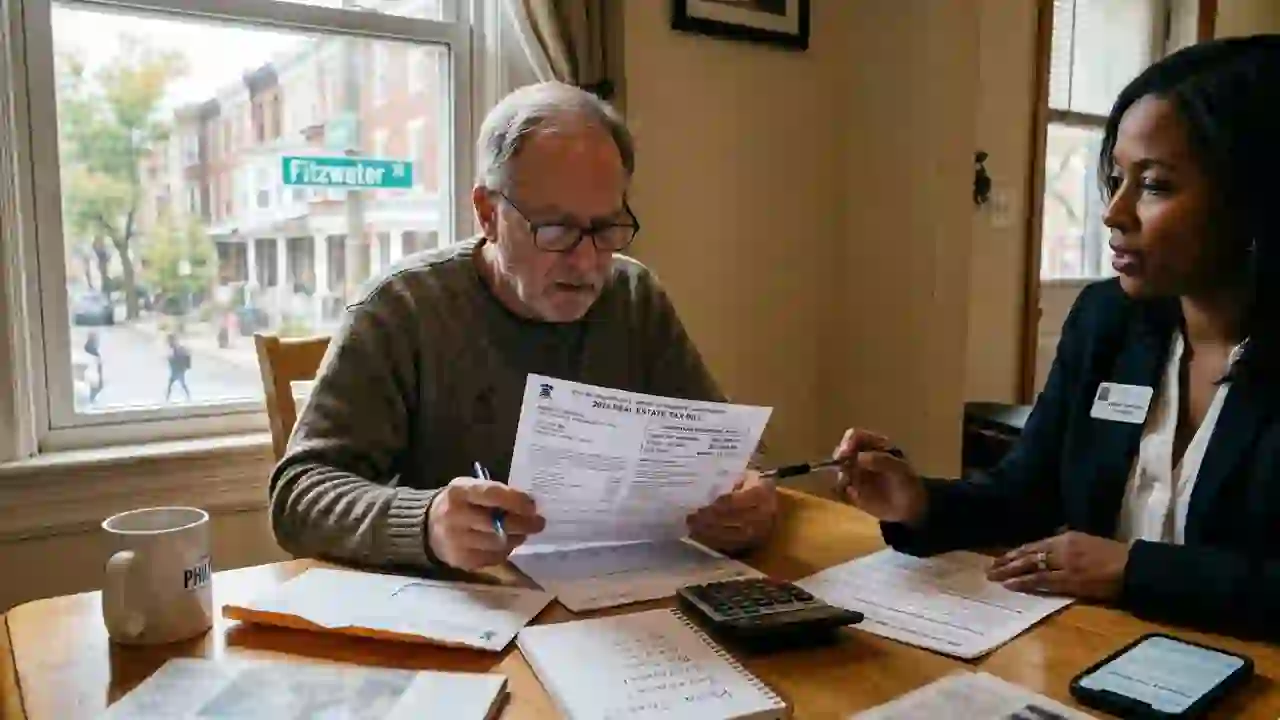
philadelphia real estate taxes
I still remember the moment I realised I had been overpaying Philadelphia property taxes for three straight years. Three years — because no one told me the Homestead Exemption existed when I bought my South Philly rowhouse. That single oversight cost me over $4,000 in savings I never recovered.
If you own property in Philadelphia — or you’re thinking about buying — this guide covers everything you need to know. The 2025 tax rate, when your bill is due, how to pay online, which exemptions you qualify for, and exactly how to fight an assessment you think is wrong.
What Are Philadelphia Real Estate Taxes?
Philadelphia real estate taxes are annual taxes imposed on every parcel of real property within city limits. It doesn’t matter whether you own a rowhouse, a condo, or a commercial building — if you own real estate in Philadelphia, you owe this tax.
Two separate taxes make up your bill: one from the City of Philadelphia and one from the School District of Philadelphia. They’re combined into a single annual bill.
Even if your mortgage lender pays through escrow, you are legally responsible for making sure the bill gets paid on time.
Philadelphia Real Estate Tax Rate for 2025
Here’s the number most people come looking for first.
For the 2025 tax year, the combined Philadelphia real estate tax rate is:
| Tax | Rate |
|---|---|
| City of Philadelphia | 0.6159% |
| School District of Philadelphia | 0.7839% |
| Combined Total | 1.3998% |
The good news: this rate has been unchanged since 2016 and remains the same in 2025. What changes your bill most years isn’t the rate — it’s your assessed property value.
How Much Are Philadelphia Property Taxes on a Typical Home?
- Home assessed at $114,400 → Annual tax: ~$1,601
- Home assessed at $300,000 (no exemptions) → Annual tax: ~$4,199
- Same $300,000 home with the Homestead Exemption → Annual tax: ~$2,800
That $1,399 difference is real money. And it’s free to claim.
How Philadelphia Property Taxes Are Calculated
The Office of Property Assessment (OPA) assesses every property in the city annually using a Computer Assisted Mass Appraisal (CAMA) system. It evaluates more than 580,000 properties to align assessed values with current market conditions.
Since Tax Year 2014, properties are assessed at 100% of market value — meaning your assessed value and your market value are the same number.
The formula is straightforward:
Taxable Value = Assessed Value − Applicable Exemptions Annual Tax = Taxable Value × 1.3998%
City Council sets the tax rate (expressed in millage), and the OPA sets your assessed value. Both affect your final bill.
When Are Philadelphia Real Estate Taxes Due?
Philadelphia real estate taxes are due on March 31 every year.
Bills are mailed every December. Here’s what happens if you miss the deadline:
- April 1: Bill becomes past due and starts accruing interest
- 1.5% monthly interest applies, up to a 15% maximum penalty by year’s end
- January 1 of the following year: Account becomes officially delinquent if unpaid or not enrolled in a payment plan
- Delinquency can trigger tax liens and eventually foreclosure
A tax lien on a Philadelphia property affects your ability to sell, refinance, and qualify for assistance programs. Pay on time — or set up a payment plan (more on that below).
How to Look Up Philadelphia Real Estate Taxes by Address
You don’t need to call anyone. The city makes this fast and free online.
To search Philadelphia real estate taxes by address:
- Go to the Philadelphia Tax Centre at tax-services.phila.gov
- Under the “Property” panel, click “Search for a property”
- Enter the street address
You’ll instantly see the OPA account number, current assessed value, outstanding balance, and payment history.
You can also use property.phila.gov to search property assessments, ownership records, and permit history — no account required.
Buyers and investors use this tool to check tax obligations before making an offer. It takes about 30 seconds and tells you a lot about carrying costs.
Searching Philadelphia Real Estate Tax Records
Philadelphia tax records are publicly accessible. You can search by:
- Street address — via property.phila.gov
- OPA number — every property has a unique 9-digit identifier; enter it directly in the Tax Centre
- Owner name — property.phila.gov supports owner name searches, useful for due diligence and title research
- Payment history — available on any property’s Tax Centre account page, including outstanding balances and active liens
If you’re wondering whether a property has back taxes, this is exactly where you look.
How to Pay Philadelphia Real Estate Taxes Online
Paying online through the Philadelphia Tax Centre is the fastest method.
- Go to tax-services.phila.gov
- Under the “Property” panel, click “Search for a property”
- Enter your address or OPA number
- Select your account and follow the payment steps
The site accepts credit cards, debit cards, and electronic checks (ACH). You don’t need an account to pay, but creating one gives you full payment history access.
Other Ways to Pay
- By mail: Check or money order with a payment voucher (print from the Tax Centre); write your OPA number and tax type on the check.
- By phone: Call (833) 913-0795
- In person: Check or money order at any of the three authorised City payment centres
General customer service: (800) 487-4567 Payment plans and Homestead Exemption help: (215) 686-6442
Philadelphia Real Estate Tax Exemptions and Relief Programs
This is the section that can save you real money. Most Philadelphia homeowners aren’t taking advantage of what’s available to them.
The Homestead Exemption (Most Widely Missed)
The Homestead Exemption reduces your assessed value by $100,000, which saves most homeowners approximately $1,399 per year starting in 2025.
Key facts:
- Available to any Philadelphia homeowner who lives in the property as their primary residence
- No income requirement. No age requirement.
- You’re still eligible if you have a mortgage or are behind on taxes
- If your home is assessed at $100,000 or less, your taxable value drops to zero — meaning no property tax at all
- Apply once; no need to reapply unless your deed changes
How to apply: Go to the Philadelphia Tax Centre, search your property, and select “Apply for real estate assistance programs.” Deadline: December 1 each year. Apply by October 1 to see the savings on your next bill.
Senior Citizen Real Estate Tax Freeze
This program locks your property tax bill at the amount you were paying when you enrolled — even if your assessment or the tax rate increases later.
For homeowners in rapidly appreciating neighbourhoods, this is enormously valuable. Application deadline: September 30, 2025.
Longtime Owner Occupants Program (LOOP)
LOOP is for homeowners who have owned and lived in their property for at least 10 years and experienced a dramatic jump in their assessed value — at least 50% in one year or 75% over five years — and who meet income requirements.
LOOP caps your taxable assessment, so your bill stays stable unless the tax rate changes. Application deadline: September 30, 2025.Low-Income Real Estate Tax Freeze
No age limit. If you qualify and are accepted, your tax bill stays the same for as long as you live in your home or until your deed changes.
Active Duty Tax Credit and Disabled Veterans Exemption
- National Guard or reserve members called to active duty outside Pennsylvania may be eligible for a property tax credit for that period.
- Homeowners (or their spouse) with a 100% service-connected disability may qualify for a full Real Estate Tax exemption.n
Owner-Occupied Payment Agreement (OOPA)
Can’t pay your full bill in one lump sum? OOPA lets you pay monthly instead. Call (215) 686-6442 to enrol in the Philadelphia Real Estate Transfer Tax in 2025
The transfer tax is a one-time tax paid when a property changes hands — it’s separate from your annual property tax.
Effective July 1, 2025, the total transfer tax rate increased to:
| Tax | Rate |
|---|---|
| City and County of Philadelphia | 3.578% |
| Commonwealth of Pennsylvania | 1.000% |
| Total | 4.578% |
This tax is traditionally split equally between buyer and seller, though it’s negotiable. On a $400,000 home, the total transfer tax would be approximately $18,312 — a significant closing cost to budget for.
Revenue from the increased rate is funding Mayor Parker’s HOME initiatives for new and refurbished housing.
Possible exemptions include family-to-family transfers, transfers to certain nonprofits, and inherited properties. Consult a real estate attorney if you think your transaction qualifies.
Philadelphia Tax Abatement: What You Need to Know
The 10-year tax abatement exempts the value of improvements to a property from taxation for a decade. During the abatement period, you only pay taxes on the land value, not the structure, which can dramatically lower your bill for new construction or major rehab projects.
Eligibility: Any homeowner or investor who pulls permits, completes construction legally, and has all tax and utility accounts current.
Important limitation: Properties with an active 10-year abatement cannot also claim the Homestead Exemption. You have to choose one or the other until the abatement expires.
When the abatement ends, the full assessed value of the property — including improvements — becomes taxable. If you’re buying a home with a soon-expiring abatement, make sure you understand exactly how much your bill will increase. This is increasingly common in real estate listings.
How to Appeal Your Philadelphia Property Tax Assessment
If you think your assessment is too high, you have the right to challenge it. Here’s how the process works.
Step 1: Request a First Level Review (FLR)
After receiving your Notice of Valuation from the OPA, file an informal First Level Review. The form typically comes with your valuation letter. This is an internal review by the OPA — no hearing required.
Step 2: File a Formal Appeal with the BRT
If the FLR doesn’t resolve your concern, file a formal appeal with the Board of Revision of Taxes (BRT).
Deadline: First Monday in October of the year before the tax year you’re disputing.
Your appeal should demonstrate at least one of the following:
- The estimated market value is too high
- Your assessed value is not uniform with comparable nearby properties
For properties assessed over $1,000,000, or any case involving a significant dollar amount, consulting a real estate attorney is strongly advisable.
BRT contact: 601 Walnut St., Suite 325 E, Philadelphia, PA 19106 OPA assessment questions: (215) 686-9200
Are Philadelphia Property Taxes High Compared to Other Cities?
Philadelphia’s combined rate of 1.3998% is actually lower than many surrounding Pennsylvania counties on a percentage basis. A comparable $600,000 home in a suburb like Tredyffrin Township — with roughly 25 mills — could run $15,000 per year in property taxes.
That said, Philadelphia’s transfer tax is considerably higher than most comparable cities, and it increased again in July 2025.
The real cost of owning in Philadelphia is heavily shaped by which exemptions you claim. A homeowner who applies for the Homestead Exemption pays meaningfully less than one who doesn’t — and most people who don’t apply simply don’t know it exists.
Frequently Asked Questions
When are Philadelphia real estate taxes due? March 31 every year. Bills are mailed in December. Interest begins accruing on April 1if unpaid.
How do I search Philadelphia real estate taxes by address? Visit property.phila.gov or the Philadelphia Tax Centre at tax-services.phila.gov. Enter the address in the search panel.
How do I apply for the Philadelphia Homestead Exemption? Go to the Philadelphia Tax Centre, search your property, and select “Apply for real estate assistance programs.” The deadline is December 1 annually. Apply by October 1 to see it reflected on your next bill.
How do I appeal my Philadelphia property tax assessment? Start with a First Level Review from the OPA after your Notice of Valuation. If needed, file a formal appeal with the Board of Revision of Taxes by the first Monday in October. Call (215) 686-9200 for guidance.
What is the City of Philadelphia Department of Revenue’s real estate taxes phone number? General questions: (800) 487-4567 | Payment plans and Homestead help: (215) 686-6442 | OPA assessment questions: (215) 686-9200 | Phone payments: (833) 913-0795
The Bottom Line
Philadelphia real estate taxes don’t have to be complicated — but they’re easy to mismanage if you don’t know the rules.
The rate is 1.3998% and has been stable since 2016. Your bill is due March 31. The Homestead Exemption is free, takes minutes to apply for, and saves most owners around $1,399 a year. Seniors, longtime owners, and low-income residents have additional freeze programs that can lock your bill in for good.
Searching tax records, checking balances, and paying online through the Philadelphia Tax Centre are all genuinely easy — the city has made these tools accessible.
One piece of advice I’d give every Philadelphia property owner: don’t assume someone else is handling this. Even if your lender pays through escrow, you are still responsible. Check your assessment every year when your Notice of Valuation arrives. Know what exemptions you qualify for. If your assessed value jumps sharply, don’t hesitate to appeal.
The city has more tools to help you than most people realise. You just have to know where to look.
For official information and to pay your bill, visit the City of Philadelphia Department of Revenue at phila.gov/revenue or the Philadelphia Tax Centre at tax-services.phila.gov.
About the Author




1 thought on “Philadelphia Real Estate Taxes 2025: Rates, Due Dates”