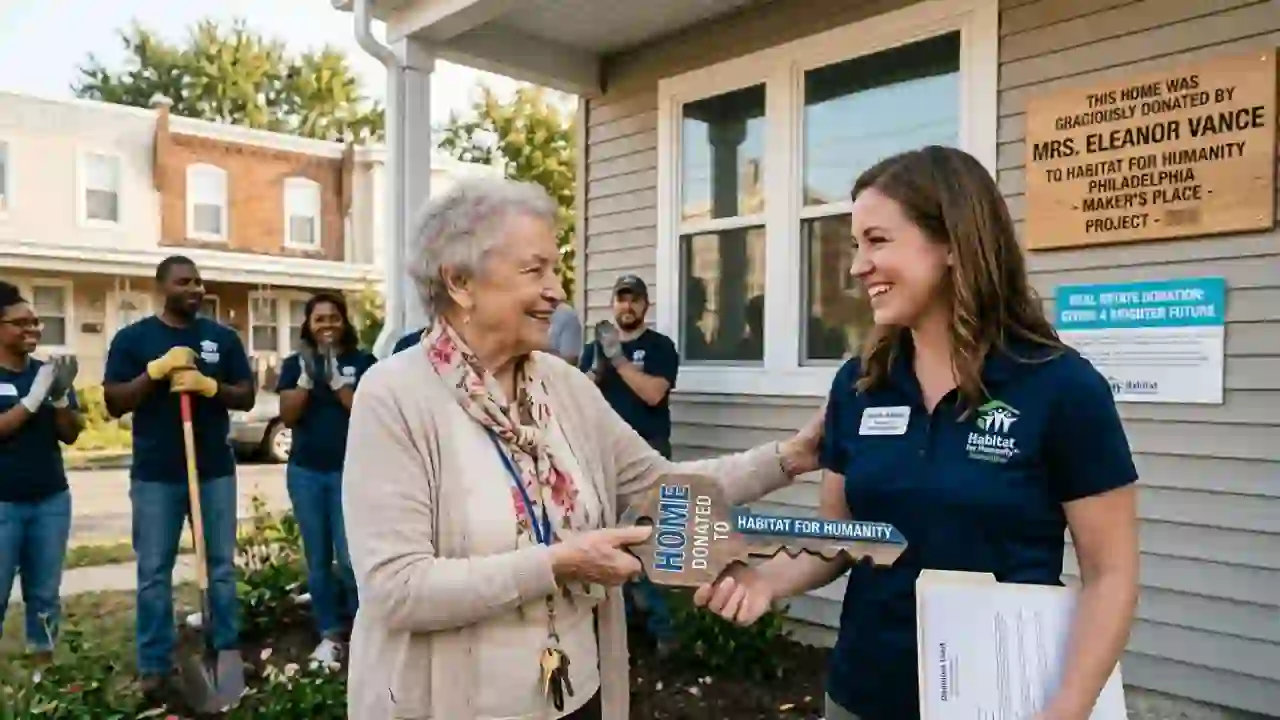
real estate donation
A few years ago, a close friend of mine inherited her grandmother’s farmhouse in rural Virginia. She lived across the country, had no plans to move, and the property needed tens of thousands in repairs. Selling seemed like the obvious move — but after sitting on the market for over a year with no serious offers, she started exploring a real estate donation instead.
Within 60 days, she had transferred the property to a local nonprofit, claimed a meaningful tax deduction, and walked away without spending another dollar on property taxes or maintenance. That experience opened my eyes to something most property owners never even consider.
If you’re sitting on a property you can’t sell, don’t want, or simply want to put toward a greater purpose, donating real estate to charity might be one of the smartest financial moves you’ll ever make.
This guide covers everything you need to know — from how the process works to the tax benefits, IRS rules, potential pitfalls, and exactly which charities accept real estate donations in 2024.
What Is a Real Estate Donation and How Does It Work?
A real estate donation is the act of transferring ownership of a property to a qualified charitable organisation — typically a 501(c)(3) nonprofit. Instead of selling the property for cash, you give it away and receive a tax deduction based on the property’s fair market value.
So how does a real estate donation work in practice? Here’s the simplified version:
- You identify a charity willing to accept your property.
- You get a qualified appraisal.
- The deed is transferred.
- You file the appropriate IRS forms and claim your deduction on your tax return.
- The charity then decides whether to use the property for its mission or sell it and use the proceeds.
Types of Properties You Can Donate
The types of properties eligible for donation include:
- Single-family homes
- Vacant land
- Commercial buildings
- Rental properties
- Vacation homes
- Agricultural land
If it has a deed, there’s a good chance it qualifies.
This process is straightforward in concept, but the details matter. Proper documentation, a qualified appraisal, and choosing the right charity are all critical to making sure your property donation holds up with the IRS.
Why Do People Choose to Donate Real Estate?
People donate real estate for a wide range of reasons. Some are deeply philanthropic. Others are making a practical financial decision. Most fall somewhere in between.
Here are the most common motivations:
Unwanted or Inherited Property
Maybe you inherited a house from a relative and have no use for it. The process for donating inherited real estate is actually simpler than most people think — and it eliminates the burden of managing a property you never asked for.
Properties That Won’t Sell
Some properties sit on the market for months or even years. Rural land, older homes in declining areas, or properties needing major repairs can be nearly impossible to move. A charitable donation of real estate offers a clean exit.
Tax Strategy
For property owners with highly appreciated assets, donating real estate to charity can be far more tax-efficient than selling. You avoid capital gains taxes and receive a deduction. That’s a rare win on both sides.
Eliminating Carrying Costs
Property taxes, insurance, maintenance, HOA fees — these add up fast. Donating removes every single one of those costs from your plate.
Real Estate Philanthropy
Some donors genuinely want to support a cause and see their property as a way to make a bigger impact than writing a check.
Tax Benefits of Donating Real Estate to Charity
This is where things get exciting — at least if you enjoy saving money on taxes. The tax benefits of donating real estate to charity are substantial.
When you donate real estate that you’ve held for more than one year, you can typically deduct the full fair market value of the property. That means if your property is appraised at $400,000, that’s the amount you can claim as a charitable deduction — regardless of what you originally paid for it.
Donating Property vs. Selling: Which Is Better for Taxes?
Compare that to selling. If you bought the property years ago for $150,000 and sell it for $400,000, you could owe significant capital gains taxes on the $250,000 in appreciation.
Is donating property better than selling for tax purposes? In many cases, yes — especially for highly appreciated property.
Key Tax Advantages at a Glance
- Property donation tax deduction: You can deduct the fair market value of long-term capital gain property, up to 30% of your adjusted gross income (AGI) in any given year.
- Capital gains avoidance: You owe zero capital gains tax on donated property. This alone can save tens of thousands of dollars.
- Five-year carryforward: If your deduction exceeds the 30% AGI limit, you can carry the unused portion forward for up to five additional tax years.
- Tax write-off for property donation: Combined with other deductions, a property donation can significantly reduce your overall tax liability.
Real-World Example
A retired couple I know donated a rental property worth $500,000 that they had purchased decades earlier for $120,000. Had they sold it, they would have owed roughly $57,000 in federal capital gains tax alone. Instead, they donated it, avoided the tax entirely, and claimed a $500,000 deduction spread across multiple tax years.
The savings were transformative for their retirement plan.
IRS Rules for Real Estate Donations You Must Know
The IRS takes noncash donations seriously, and real estate donations receive extra scrutiny. Understanding the rules up front will save you headaches later.
Qualified Appraisal Requirements
For any donated property valued over $5,000, the IRS requires a qualified independent appraisal. Key requirements include:
- The appraisal must be conducted no earlier than 60 days before the donation and no later than the due date of your tax return.
- The appraiser must meet specific IRS qualifications under Treasury Regulation 1.170A-17.
How is donated real estate valued for tax deduction? Entirely through this qualified appraisal process.
IRS Form 8283
You must file IRS Form 8283 for noncash charitable contributions exceeding $500. For donations over $5,000, you’ll need to complete Section B, which includes a summary of the appraisal. The charity must also sign this form acknowledging receipt of the property.
IRS Form 8282
If the charity sells the property within three years of receiving it, it must file Form 8282 reporting the sale. This doesn’t affect your deduction, but it creates a paper trail the IRS can review.
Deduction Limits
- For appreciated property held longer than one year: deduction capped at 30% of AGI.
- You can elect to use cost basis instead, which raises the limit to 50% of AGI but reduces the deduction amount.
Overvaluation Penalties
If the IRS determines that you overstated the property’s value by 150% or more, you face a 20% penalty on the underpayment of tax. At 200% or more, the penalty jumps to 40%. This is why choosing a reputable, qualified appraiser is essential.
Partial Interest Rules
Generally, you cannot deduct a donation of a partial interest in property. Exceptions exist for:
- Undivided fractional interests
- Remainder interests in a personal residence or farm
- Qualified conservation easements
How to Donate Real Estate to a Nonprofit: Step-by-Step Process
If you’re wondering how to donate real estate to a nonprofit, here’s the process laid out clearly.
Step 1: Confirm Your Property Qualifies
The property should ideally be free of significant liens or mortgages. If there’s a mortgage, it becomes a “bargain sale” situation, which triggers partial capital gains. Environmental issues like contamination can also complicate or prevent a donation.
Step 2: Choose a Qualified Charity
The organisation must be a 501(c)(3). You can verify any organisation’s status using the IRS Tax Exempt Organisation Search tool. Look for charities that accept real estate donations specifically — not all nonprofits have the infrastructure to handle property transfers.
Step 3: Get a Qualified Appraisal
Hire an appraiser who meets IRS requirements. The donated real estate appraisal determines your deduction, so accuracy matters enormously.
Step 4: Transfer the Deed
Work with a real estate attorney to handle the legal transfer of ownership. This includes a title search, preparing the deed, and recording the transfer with the county.
Step 5: File Your Tax Forms
Complete Form 8283, attach the appraisal summary, file with your tax return, and claim the deduction on Schedule A.
Step 6: Keep Your Records
Maintain copies of everything:
- The appraisal
- Correspondence with the charity
- The deed
- Form 8283
- Any acknowledgement letters from the nonprofit
If the IRS ever questions your deduction, thorough documentation is your best defence.
Which Charities Accept Real Estate Donations?
Not every charity is equipped to accept property, but many well-known organisations do. Here are some options:
- Habitat for Humanity — Accepts donated properties in many markets and uses them to support affordable housing.
- Local land trusts and conservation organisations — Excellent options for land donation for tax benefits, especially if your property has environmental or agricultural significance.
- Universities and hospitals often accept real estate through their development offices, using the proceeds to fund programs and scholarships.
- Religious organisations sometimes accept property donations to support their missions.
- Specialised donation programs — Organisations like Real Estate with Causes act as intermediaries, handling the entire process from appraisal through sale.
Finding Real Estate Donations Near You
If you’re searching for real estate donations near me, start by contacting local nonprofits or community foundations. Many communities have organisations specifically designed to receive and manage donated properties.
It’s also worth noting that some banks donate property to nonprofit organisations after foreclosure. These bank-donated properties help nonprofits access real estate for community development, affordable housing, and other programs.
Can You Donate Real Estate to a Donor-Advised Fund?
Yes, many donor-advised funds (DAFs) accept real estate contributions. A DAF allows you to make a charitable contribution, receive an immediate tax deduction, and then recommend grants from the fund over time.
How It Works
You transfer the property, the DAF sells it, and the proceeds go into your charitable account. You avoid capital gains tax and get the deduction upfront.
Downsides of Using a DAF for Real Estate Donations
However, there are downsides worth considering:
- The DAF sponsor has legal control over the funds once donated. Your grant recommendations are advisory, not binding.
- DAFs have faced criticism for allowing funds to sit indefinitely without being distributed to working charities.
- The due diligence process for accepting real estate into a DAF can be lengthy.
- Some sponsors charge significant fees on illiquid asset contributions.
Despite these drawbacks, DAFs remain one of the more flexible options for donors who want ongoing involvement in how their charitable dollars are deployed.
Donating Property to a Family Member: Is That an Option?
Some property owners wonder whether they should donate their property to charity or keep it in the family. While this guide focuses on charitable giving, it’s worth addressing the question: What is the best way to leave property to your children?
A donation of property to a family member is not a charitable donation, and you won’t receive a tax deduction for it. Instead, it’s treated as a gift. If the value exceeds the annual gift tax exclusion ($18,000 per recipient in 2024), you’ll need to file a gift tax return using IRS Form 709.
For many families, better approaches include:
- Transferring property through a trust
- Using a transfer-on-death deed
- Including the property as part of a comprehensive estate plan
Consulting an estate planning attorney is strongly recommended.
Donating Depreciated Real Estate to Charity: What You Should Know
What about donating depreciated real estate to charity? This situation is common with rental properties where you’ve claimed depreciation deductions over the years.
When you donate depreciated property, the rules work differently from those with appreciated property:
- Your deduction may be limited to the property’s current fair market value, which could be less than what you originally paid.
- There may be depreciation recapture considerations to discuss with your tax advisor.
In some cases, selling the property and donating the cash proceeds might actually produce a better tax outcome than donating the property directly. This is one area where professional tax advice isn’t optional — it’s essential.
The 50/30/20 Rule and How It Applies to Real Estate Donations
You might have come across the 50/30/20 rule for donations in the context of personal finance. Traditionally, this budgeting framework suggests allocating:
- 50% of income to needs
- 30% to wants
- 20% to savings and debt repayment
Some financial advisors adapt this framework to include charitable giving within the 20% category, treating donations as part of your overall financial plan rather than an afterthought.
When it comes to real estate charitable giving, the key is ensuring that your donation fits within your broader financial picture. A property donation that creates a massive tax deduction might free up cash flow you can redirect toward savings, investments, or other goals.
The takeaway? Don’t donate real estate in isolation. Consider how it fits within your total financial strategy.
Can I Donate My House to Charity Instead of Selling It?
This is one of the most common questions I hear — and the answer is yes, absolutely. You can donate a house to charity instead of selling it, and in many situations, it makes more financial sense.
Selling vs. Donating: Cost Comparison
When you sell, you pay:
- Real estate agent commissions (typically 5%–6%)
- Closing costs
- Potential capital gains taxes
- Possible repair costs to make the property market-ready
When you donate, you skip all of that — and receive a tax deduction on top.
When Does Donation Make the Most Sense?
Donation makes the most sense when:
- The property is highly appreciated
- The property is difficult to sell
- You’re in a high tax bracket where the deduction provides substantial value
That said, donation isn’t always the right choice. If you need the cash proceeds from a sale to fund a purchase or cover living expenses, selling may be the better path. The decision ultimately comes down to your financial situation, the property’s characteristics, and your charitable intentions.
What Happens When You Donate Land to a Charity?
Land donations follow the same general process as other real estate donations. The charity receives ownership, you get a deduction, and the organisation can use the land for its mission or sell it.
Conservation Easements
Conservation easements are a particularly popular form of land donation. By donating a conservation easement, you restrict future development on the property while potentially retaining ownership. This can produce significant tax benefits while preserving environmentally important land.
However, conservation easement donations have attracted increased IRS scrutiny in recent years — particularly syndicated conservation easements. Make sure any land donation for tax benefit is structured properly with qualified legal and tax guidance.
Potential Risks and Pitfalls of Real Estate Donations
No guide would be complete without an honest discussion of the risks.
Environmental Liability
If the property has contamination issues, you could face liability even after transfer. A Phase I environmental assessment is wise for any commercial or industrial property.
Audit Risk
Large noncash charitable contributions are among the items most likely to trigger an IRS audit. Proper documentation is your shield.
Charity Rejection
Some nonprofits will decline properties in poor condition, in undesirable locations, or with legal complications. Don’t assume every charity will say yes.
Mortgage Complications
Donating property with outstanding debt triggers bargain sale rules. You may owe capital gains tax on the portion of value attributable to the mortgage. Many charities simply won’t accept mortgaged property.
Appraisal Disputes
The IRS can challenge your appraised value. If they determine the property was overvalued, you face penalties and a reduced deduction.
Frequently Asked Questions About Real Estate Donations
How Do I Find Charities That Accept Real Estate Donations Near Me?
Start with local community foundations, Habitat for Humanity chapters, and land trusts in your area. You can also search the IRS Tax Exempt Organisation database to verify any organisation’s 501(c)(3) status before donating. Specialised real estate donation programs can also connect you with qualified nonprofits nationwide.
What Is the Process for Donating Inherited Real Estate?
The process mirrors a standard real estate donation. You’ll need to confirm that the estate has been settled and the title is in your name, then obtain a qualified appraisal, select a charity, transfer the deed, and file Form 8283 with your tax return. Inherited property often benefits from a stepped-up cost basis, so the tax implications may differ from other donations.
How Do I Transfer Ownership of Property to a Nonprofit Organisation?
Work with a real estate attorney to prepare and record a new deed transferring ownership from you to the nonprofit. This typically involves a title search, preparation of a warranty or quitclaim deed, and recording the deed with your county recorder’s office. The nonprofit should provide a written acknowledgement of the gift.
Is Donating Real Estate Better Than Selling for Tax Purposes?
It depends on your situation. If the property has appreciated significantly and you’re in a high tax bracket, donating often produces a better financial outcome because you avoid capital gains taxes and receive a fair market value deduction. If you need cash from the sale or the property hasn’t appreciated much, selling might be more practical. A tax advisor can run the numbers for your specific circumstances.
What Are the Benefits of Donating Real Estate to Charity vs. Keeping the Property?
The benefits of donating real estate to charity include eliminating ongoing carrying costs like property taxes, insurance, and maintenance. You receive a potentially large tax deduction, avoid capital gains taxes, and support a cause you care about. Keeping the property only makes sense if it generates income, appreciates, or serves a personal purpose.
Final Thoughts: Is a Real Estate Donation Right for You?
Real estate donation is one of the most underused yet powerful tools in both charitable giving and tax planning. Whether you’re looking to offload an inherited property, contribute to a cause you believe in, or simply make a smart financial decision, donating real estate to charity deserves serious consideration.
From my own experience watching friends, colleagues, and clients navigate this process, the people who have the smoothest experience are the ones who plan. They choose their charity carefully, hire qualified professionals for the appraisal and legal transfer, and work with a CPA who understands the nuances of noncash charitable contributions.
The process isn’t complicated, but it does require attention to detail. The IRS rules are specific, and the documentation requirements are real. Cut corners, and you risk penalties, audit headaches, or a disallowed deduction. Do it right,t and you could save tens of thousands of dollars while making a genuine difference.
If you’re even considering this path, start by talking to a tax advisor who can evaluate your specific situation. Then explore which charities accept real estate donations in your area. You might be surprised at how many doors open once you take that first step.
A gift of property to a nonprofit isn’t just a transaction — it’s a legacy. And in my experience, the donors who go through this process never regret it.
About the Author