blue origin
I’ll never forget watching Jeff Bezos emerge from that capsule in the Texas desert, grinning ear to ear. It was July 2021, and the Amazon founder had just returned from space aboard his own rocket.
That moment changed everything. Suddenly, space wasn’t just for astronauts anymore.
What is Blue Origin? Can regular people actually fly to space? And more importantly, how much does it really cost?
Let me share everything I’ve learned about this fascinating company after years of following their journey.
What Is Blue Origin? The Complete Answer
Blue Origin is a private aerospace company founded by Jeff Bezos in 2000 that builds rockets and spacecraft to make space accessible to everyone.
Unlike traditional aerospace contractors, this commercial spaceflight company focuses exclusively on reusable rocket technology. Their goal? Take people and cargo beyond Earth’s atmosphere safely and affordably.
Here’s what makes them unique:
Their Mission: Enable millions of people to live and work in space to preserve Earth.
Their Motto: “Gradatim Ferociter” (Step by Step, Ferociously).
Their Approach: Methodical testing and safety over speed.
Think of Blue Origin as the careful engineer, while SpaceX is the bold innovator. Both approaches matter. Both are changing spaceflight forever.
The company runs three major programs right now:
New Shepard takes space tourists on suborbital flights where they experience weightlessness and see Earth from space.
New Glenn is their orbital rocket currently in development, designed to compete in the satellite launch market.
BluOriginon is their lunar lander program that will return humans to the Moon as part of NASA’s Artemis program.
This isn’t just another tech billionaire’s vanity project. Blue Origin is building real infrastructure for space exploration missions that could change humanity’s future.
Does Jeff Bezos Still Own Blue Origin?
Yes, Jeff Bezos owns 100% of Blue Origin and has since its founding in 2000.
The Blue Origin owner keeps the company entirely private. No venture capital. No public shareholders. Just Bezos is funding the vision through Amazon stock sales.
Here’s what’s fascinating about this structure:
Bezos invests approximately one billion dollars every year into Blue Origin. That level of patient capital is extremely rare in aerospace.
When you search for Blue Origin stock, you won’t find any shares to purchase. The company deliberately avoids public markets to maintain complete strategic control.
This private ownership creates three major advantages:
Freedom from quarterly pressure: Blue Origin can test thoroughly without investors demanding faster returns.
Long-term thinking: They can pursue decades-long goals that public companies couldn’t justify.
Strategic flexibility: Bezos can pivot direction without shareholder approval.
The downside? Limited transparency. We don’t know exact revenues, profit margins, or detailed financials.
But here’s the important part: Bezos isn’t just writing checks. After stepping down as Amazon CEO, he dedicates significant personal time to Blue Origin’s strategy and operations.
He’s the founder, owner, primary funder, and active leader. This is his passion project for humanity’s future in space.
How Blue Origin Works: The New Shepard Rocket Explained
Let me break down exactly how Blue Origin’s space tourism rocket operates.
The New Shepard System
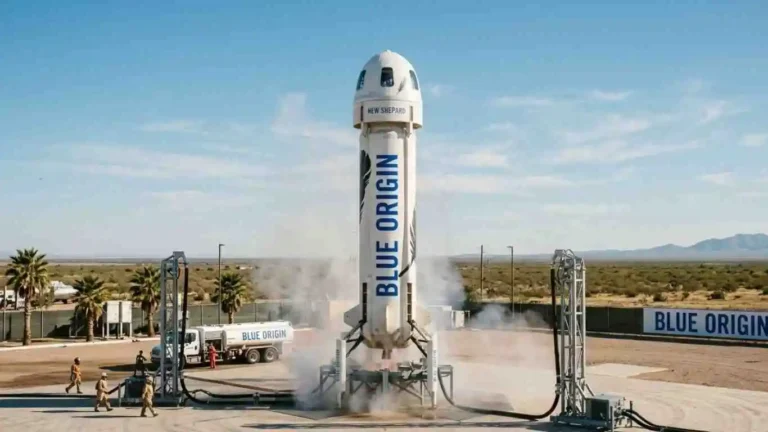
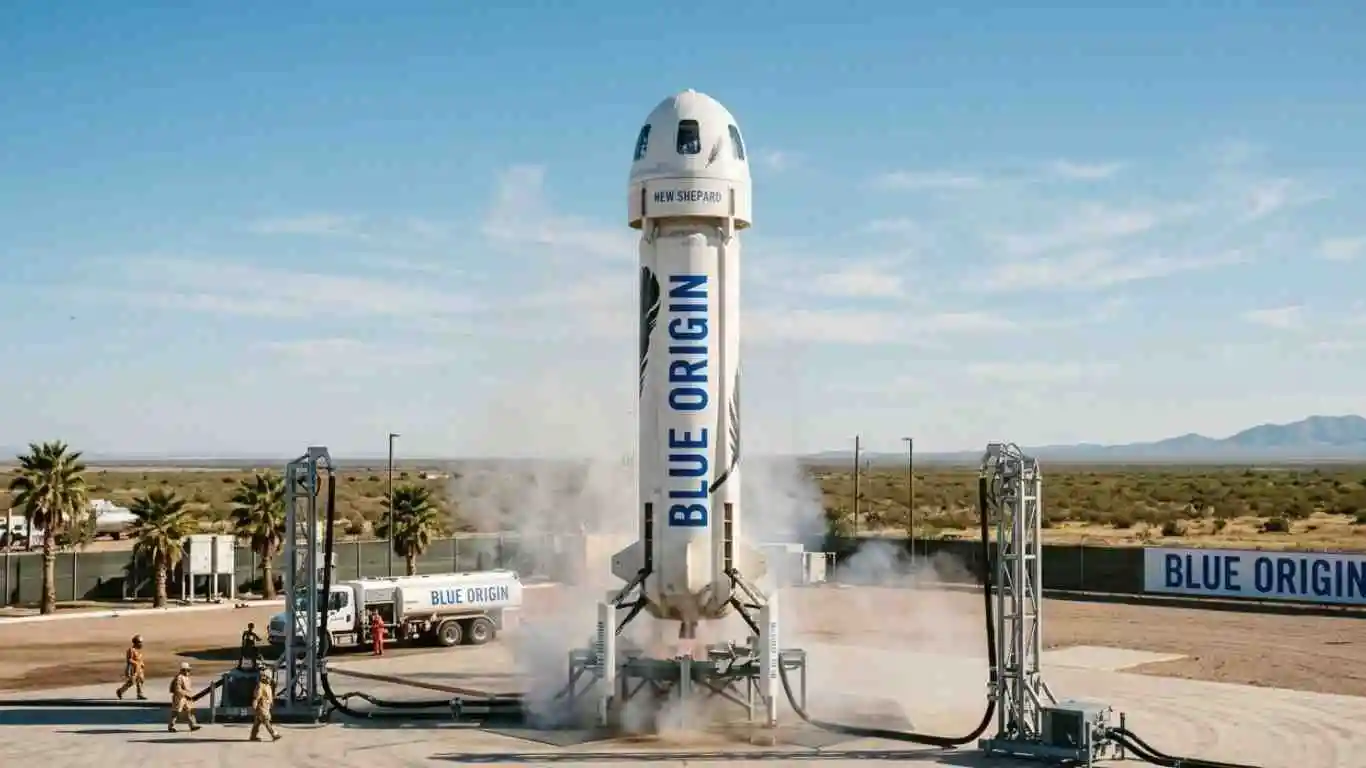
New Shepard stands 60 feet tall and consists of two main components working together:
The Reusable Booster: A rocket that provides thrust to reach space, then returns to Earth and lands vertically.
The Crew Capsule: Carries six passengers to space and returns them safely using parachutes.
Here’s the flight sequence step by step:
Launch: The booster fires, accelerating the capsule skyward at three times Earth’s gravity.
Separation: At the edge of space, the capsule separates from the booster around 250,000 feet.
Weightlessness: Passengers unbuckle and float for 3 to 4 minutes while crossing the Karman line at 100 kilometres altitude.
Descent: The capsule deploys parachutes and uses retro thrusters for a gentle landing.
Booster Return: Meanwhile, the booster re-ignites its engines and lands vertically on its own pad.
Why Reusable Rocket Technology Matters
Traditional rockets are expendable. Use once, throw away. It’s like buying a new aeroplane for every flight.
Blue Origin designed New Shepard to fly repeatedly. The same booster has launched dozens of times, dramatically reducing costs per flight.
I’ve watched numerous Blue Origin rocket launch schedule events online. The precision is genuinely impressive. That booster screams back from space, fires its engines at the perfect moment, and settles onto the landing pad like it’s routine.
Every successful landing brings reusable spaceflight closer to everyday reality.
The crew capsule features the largest windows ever flown to space. These massive windows aren’t just for show. They provide breathtaking, unobstructed views of Earth that define the entire experience.
Blue Origin Ticket Price: What Space Tourism Actually Costs
Now for the question everyone asks: how much does it cost to fly on Blue Origin?
Current Pricing Estimates
Blue Origin hasn’t published official ticket prices, but industry sources estimate $200,000 to $300,000 per seat.
That’s serious money. No sugarcoating it.
For perspective:
A Blue Origin suborbital flight costs roughly what a nice house costs in many American cities.
SpaceX charges $55 million for orbital flights, making Blue Origin comparatively accessible.
Virgin Galactic sells tickets for round $450,000 for similar suborbital experiences.
The first Blue Origin seat sold at auction for $28 million, though that was charity fundraising, not standard pricing.
What Your Blue Origin Space Tourism Ticket Includes
Here’s exactly what you get for that investment:
Pre-Flight Training: Full day of safety procedures, capsule familiarisation, and flight preparation.
Medical Screening: Basic health check to ensure you can safely experience launch forces and weightlessness.
The Flight Experience: 11 minutes from launch to landing, including 3 to 4 minutes of pure weightlessness.
Six Passenger Crew: You’ll fly with five other space tourists in an intimate, shared experience.
Massive Windows: Unobstructed views through the largest space windows ever built.
Zero Gravity Freedom: Unbuckle, float, do flips, and experience what astronauts feel.
Safe Return: Multiple redundant safety systems ensure you land safely back on Earth.
The Reality Check
Eleven minutes of flight time for $200,000 plus means you’re paying roughly $18,000 per minute.
Is it worth it?
Wally Funk thought so. The 82-year-old aviator who flew on Bezos’s first crewed mission had waited 60 years for those minutes. Her pure joy was absolutely genuine and deeply moving.
Everyone who’s flown describes it as life-changing. That said, only you can decide if the cost justifies the experience.
Blue Origin space tourism tickets currently sell through private sales and are invitation-only. There’s no public booking system yet. If you’re serious about flying, you’ll need to contact Blue Origin directly and join their waiting list.
Blue Origin vs SpaceX: The Real Differences That Matter
People constantly ask: Is Blue Origin better than SpaceX?
That’s the wrong question. They’re fundamentally different companies pursuing different strategies.
Let me explain the real differences:
Company Philosophy
SpaceX: Move fast, break things, iterate rapidly. Elon Musk embraces public failures as learning opportunities.
Blue Origin: Test thoroughly, prioritise safety, and develop methodically. Jeff Bezos values careful engineering over speed.
Neither approach is wrong. They’re different paths to similar goals.
Mission Focus
SpaceX concentrates on:
- Mars colonization as the ultimate goal
- Orbital flights to the International Space Station
- Starlink satellite internet deployment
- Heavy lift cargo missions
Blue Origin focuses on:
- Suborbital space tourism is the current revenue source
- Gradual development of orbital capabilities
- Lunar landing systems for NASA
- Long-term space infrastructure
Current Capabilities
Here’s where they stand today:
SpaceX operates regularly, launching satellites, cargo, and astronauts to orbit multiple times monthly.
Blue Origin flies New Shepard occasionally for tourism and is still developing New Glenn for orbital operations.
SpaceX is further along operationally. Blue Origin is earlier in its development timeline.
Flight Comparison
SpaceX Tourism: Multi-day orbital flights reaching 200-plus miles altitude, costing $55 million per seat.
Blue Origin Tourism: 11-minute suborbital flights reaching 66 miles altitude, costing $200,000 to $300,000 per seat.
Different experiences entirely. SpaceX offers extended time in orbit. Blue Origin offers brief but intense edge-of-space experiences.
The Bottom Line on Blue Origin vs SpaceX
SpaceX is the scrappy innovator pushing boundaries aggressively. Blue Origin is the careful engineer building sustainable systems for the long haul.
The space industry benefits from both approaches. Competition drives innovation. Different strategies test different assumptions.
SpaceX doesn’t need Blue Origin to fail. Blue Origin doesn’t need to beat SpaceX. Both can succeed by executing their distinct visions effectively.
Blue Origin Explosion: Addressing the Safety Concerns
Whenever I discuss Blue Origin with friends, someone inevitably asks about explosions or safety issues.
Let me address this directly and honestly.
The 2022 Uncrewed Booster Failure
Blue Origin experienced one significant failure in September 2022 during an uncrewed research mission.
Here’s exactly what happened:
The New Shepard booster experienced a thermostructural failure about one minute into flight. The escape system immediately detected the problem and activated, rocketing the capsule away from the failing booster.
The capsule landed safely under parachutes. No one was injured because no people were aboard.
The booster was destroyed in the failure.
What This Incident Actually Proved
People searching for “Blue Origin exploding” usually reference this incident. But here’s what matters:
The safety systems worked perfectly. If passengers had been aboard, they would have survived without injury.
This wasn’t a design flaw in the safety systems. It was a component failure that the safety systems successfully mitigated.
Blue Origin grounded flights, investigated thoroughly, identified the root cause, implemented fixes, and resumed operations only after rigorous review.
Blue Origin’s Perfect Crewed Flight Record
The critical statistic: Blue Origin has never had a crewed flight failure.
Every flight carrying humans has launched successfully and landed safely. That’s a perfect safety record where it matters most.
Compare this to industry norms:
SpaceX has experienced multiple test failures and explosions during development. That’s normal in aerospace.
Virgin Galactic suffered a tragic accident in 2014 that killed a test pilot during development.
Every aerospace company experiences failures during testing. What matters is learning from them and building robust safety systems.
The Conservative Approach Advantage
Blue Origin flies less frequently than SpaceX, but when they do fly with people aboard, they’ve maintained 100% success.
For a company taking civilians to space, that conservative, safety-first approach matters enormously.
New Shepard completed 15 uncrewed test flights before carrying the first passengers. That methodical testing paid off with a reliable system.
Blue Origin’s Moon Mission: The Blue Moon Lunar Project
Beyond space tourism, Blue Origin’s space mission planning extends ambitiously to the Moon.
What Is the Blue Moon Lunar Lander?
Blue Moon is a lunar lander designed to deliver cargo and eventually humans to the Moon’s surface as part of NASA’s Artemis program.
This isn’t a small side project. NASA selected Blue Origin through a competitive process, awarding a multi-billion-dollar contract that validates Blue Origin as a serious aerospace contractor.
How Blue Moon Works
The Blue Moon lunar landing project uses innovative technology:
BE-7 Engine: Specifically designed for lunar operations, burning hydrogen and oxygen.
Sustainable Fuel: Both propellants can potentially be sourced from lunar ice, enabling long-term operations.
Heavy Payload Capacity: Designed to deliver multiple tons of cargo to the lunar surface.
Human Rating Capable: Eventually able to carry astronauts safely to and from the Moon.
The Competition and Challenges
Blue Origin faces stiff competition, particularly from SpaceX’s Starship lunar variant.
However, Blue Origin brings unique advantages:
They partner with major aerospace companies, including Lockheed Martin, Draper, and Boeing. This spreads risk and combines deep expertise.
Their engine technology is specifically optimised for lunar conditions rather than adapted from other purposes.
Their methodical approach may prove valuable for crewed lunar missions where safety is paramount.
Why the Moon Program Matters
I find this program particularly exciting because it represents Blue Origin’s evolution from tourism to serious exploration.
They’re not just giving wealthy people joy rides. They’re building systems that could support permanent human presence beyond Earth.
If Blue Origin successfully lands astronauts on the Moon as part of Artemis, it cements their reputation as a premier aerospace contractor capable of the most demanding missions.
New Glenn Rocket: Blue Origin’s Path to Orbital Launch Services
While New Shepard handles suborbital tourism, the New Glenn rocket represents Blue Origin’s entry into the orbital market.
New Glenn Specifications
Height: 270 feet tall, dwarfing the 60-foot New Shepard.
Payload Capacity: 45 metric tons to low Earth orbit.
Reusability: First stage returns and lands on a ship at sea, similar to SpaceX’s approach.
Competition: Designed to compete directly with SpaceX’s Falcon 9 and Falcon Heavy.
Engine: Powered by seven BE-4 engines that Blue Origin also sells to United Launch Alliance.
Development Timeline and Delays
Here’s the truth: New Glenn is taking longer than originally planned.
Blue Origin initially targeted a 2020 first flight. As of 2024, they’re still working toward that inaugural launch.
Critics point to these delays as evidence that Blue Origin moves too slowly. Supporters argue they’re building it right rather than rushing.
Both perspectives have merit. Delays cost contracts and momentum. But launching before you’re ready costs credibility and potentially lives.
Why New Glenn Matters for Blue Origin’s Future
When New Glenn finally flies successfully, it transforms Blue Origin’s business model.
Current revenue sources are limited: tourism tickets, engine sales, and government contracts.
Operational New Glenn opens enormous new markets:
Commercial Satellite Launches: Already contracted with Telesat, OneWeb, and others.
Government Missions: Potential NASA and military contracts for orbital operations.
Space Station Support: Possible cargo and eventually crew missions.
Financial Sustainability: Revenue sufficient to reduce dependence on Bezos’s personal funding.
The BE-4 engine powering New Glenn already generates income. United Launch Alliance purchases these engines for their Vulcan rocket, demonstrating confidence in Blue Origin’s engine technology.
Success with New Glenn could make Blue Origin financially sustainable and operationally competitive with SpaceX in the orbital market.
How Blue Origin Actually Makes Money Today
Let’s talk honestly about Blue Origin’s business model and financial sustainability.
Current Revenue Streams
Blue Origin generates income through several channels:
Space Tourism Tickets: Revenue from New Shepard flights, though exact amounts remain private.
BE-4 Engine Sales: United Launch Alliance purchases engines for its Vulcan rocket.
NASA Contracts: Multi-billion dollar lunar lander development contracts.
Future Satellite Launches: Advance contracts for New Glenn missions.
The Profitability Reality
Here’s the truth: Blue Origin is not profitable yet.
They’re still in heavy investment and development mode. Jeff Bezos’s continued funding of approximately one billion dollars annually allows them to operate without immediate profit pressure.
This raises legitimate questions about long-term sustainability. Can Blue Origin eventually function without Bezos’s personal funding?
The Amazon Comparison
I compare it to Amazon’s early years. Amazon operated at a loss for years while building infrastructure, customer base, and market position.
Bezos understands long-term value creation better than almost anyone. He’s applying that same patient capital approach to Blue Origin.
The space industry rewards companies willing to invest heavily up front. SpaceX operated at a loss for years before becoming profitable. Blue Origin is following a similar path with different priorities anda timeline.
Path to Profitability
Blue Origin’s route to financial independence depends on three factors:
New Glenn Success: Operational orbital rocket generating regular launch revenue.
Scaled Tourism: More frequent New Shepard flights with optimised operations.
Government Contracts: Continued NASA and military contracts for specialised capabilities.
If they execute on these three fronts, Blue Origin could become self-sustaining within this decade.
Blue Origin Latest Launch Updates and News
Staying current with Blue Origin requires knowing where to find reliable information.
Official Information Sources
Blue Origin Website: The most authoritative source for Blue Origin rocket launch schedule updates and company announcements.
Blue Origin X Account: Their social media presence (formerly Twitter) shares launch updates and milestones, though less frequently than SpaceX.
Press Releases: Official statements provide detailed technical and business updates.
Unlike SpaceX’s constant social media activity and Elon Musk’s Twitter presence, Blue Origin maintains a quieter public profile.
This reflects their different corporate personalities. SpaceX leverages Musk’s celebrity for free publicity. Blue Origin lets the engineering speak for itself.
Recent Developments Worth Knowing
Blue Origin has resumed New Shepard tourism flights after the 2022 uncrewed failure and subsequent investigation.
New Glenn development continues at their Florida facility, with the first launch expected in 2024 or 2025.
The Blue Moon lunar lander program advances through design reviews and testing phases for NASA’s Artemis program.
BE-4 engine production continues for both New Glenn and United Launch Alliance’s Vulcan rocket.
How to Follow Blue Origin Progress
For the latest Blue Origin news and developments:
Visit their official website regularly for announcements.
Follow their verified social media accounts for updates.
Check aerospace news outlets like SpaceNews, Ars Technica, and NASA Spaceflight for detailed coverage.
Watch for FAA licensing updates that signal upcoming launch activity.
The company doesn’t generate SpaceX-level buzz, but significant developments happen regularly for those paying attention.
Inside Blue Origin: Company Culture and Career Opportunities
Blue Origin employs approximately 10,000 people across facilities in Washington, Florida, Texas, Alabama, and California.
What It’s Like Working There
The company culture emphasises their “Step by Step, Ferociously” motto in everything they do.
Employees describe a methodical, eengineering-focused environmentwhere safety and precision outweigh speed and flashy demonstrations.
Career Opportunities and Requirements
Common career areas include:
Aerospace Engineering: Rocket design, propulsion systems, structural analysis.
Software Development: Flight systems, simulation, operations software.
Manufacturing: Rocket production, engine assembly, quality control.
Mission Operations: Launch operations, flight control, mission planning.
Business Operations: Contracts, finance, human resources, legal.
One significant requirement: Most positions require U.S. citizenship due to ITAR regulations governing rocket technology. This is standard across American aerospace companies bu but mits the available talent pool.
Salaries are competitive with aerospace industry standards, though perhaps not matching big tech companies. However, working on actual rockets that fly to space offers intangible rewards.
Workplace Culture Concerns
Blue Origin has faced criticism regarding workplace culture from some former employees who described challenging conditions, unrealistic deadlines, and safety culture concerns.
Blue Origin disputes these characterisations and maintains that they prioritise employee well-being and safety.
Like any large organisation, experiences vary. Prospective employees should research thoroughly and talk with current staff when possible.
Visit blueorigin.com/careers for current openings and detailed information.
What Comes Next for Blue Origin
Where does Blue Origin go from here? Several critical milestones loom on the horizon.
Short Term Priorities
New Glenn First Flight: This is absolutely critical for Blue Origin’s credibility as a full-service aerospace company. Continued delays cost contracts and momentum. A successful inaugural flight changes everything.
Tourism Scaling: Flying occasional millionaires generates headlines but doesn’t build a sustainable business. Blue Origin space tourism tickets need to become routine, frequent, and eventually more affordable.
Artemis Execution: NASA chose Blue Origin for lunar lander development. They must deliver on this multi-billion-dollar contract to cement their reputation as a premier aerospace contractor.
Long Term Vision
Bezos talks about moving heavy industry off Earth to preserve our planet’s environment. He envisions millions of people living and working in space within generations.
That sounds like science fiction, but someone needs to build the foundational infrastructure. Blue Origin is laying the groundwork that might not pay off for decades.
Realistic Assessment
I’m cautiously optimistic about Blue Origin’s future.
They have real technology that works. New Shepard has proven that reusable rockets are viable.
They have essentially unlimited funding as long as Bezos remains committed.
They have genuine technical talent, building impressive systems.
They just need to translate New Shepard’s success to their larger, more ambitious programs.
The space industry has room for multiple successful companies. Blue Origin doesn’t need to beat SpaceX. They need to execute their own distinct vision effectively.
Frequently Asked Questions About Blue Origin
Does Jeff Bezos still own Blue Origin?
Yes, Jeff Bezos owns 100% of Blue Origin with no outside investors or publicly traded stock. He funds the company primarily through selling Amazon shares, investing approximately one billion dollars annually. This private ownership allows Blue Origin to focus on multi-decade goals without quarterly earnings pressure from public shareholders.
What exactly does Blue Origin do?
Blue Origin builds rockets and spacecraft for space tourism and exploration missions. Their New Shepard rocket provides 11-minute suborbital flights for paying customers who experience weightlessness and see Earth from space. They’re developing New Glenn for orbital satellite launches and Blue Origin for NASA’s lunar landing program. The company also manufactures rocket engines sold to other aerospace companies.
How much does it cost to fly on Blue Origin?
Blue Origin hasn’t published official pricing, but industry estimates place the Blue Origin ticket price between $200,000 and $300,000 per seat. This includes pre-flight training, medical screening, the 11-minute flight experience with 3 to 4 minutes of weightlessness, and all associated services. Tickets are currently sold through private invitation rather than public booking systems.
Is Blue Origin better than SpaceX?
Blue Origin and SpaceX excel at different missions and aren’t directly comparable. SpaceX dominates orbital launch services, space station missions, and satellite deployment through rapid innovation. Blue Origin focuses on suborbital tourism and methodical safety-focused development. SpaceX operates more frequently; Blue Origin prioritises careful testing. Neither is objectively better as they serve different markets with complementary approaches.
Has Blue Origin had any explosions or accidents?
Blue Origin experienced one uncrewed booster failure in September 2022 during a research mission. The capsule escape system activated perfectly, and no one was injured since no passengers were aboard. Blue Origin has never had a crewed flight failure. Their safety record for human spaceflight remains perfect across all passenger-carrying missions, though they fly less frequently than some competitors.
My Final Take After Years of Following Blue Origin
After researching and tracking Blue Origin for several years, I’ve developed genuine respect for what they’re building.
They don’t generate SpaceX-level excitement or Twitter drama. But they’re doing serious, methodical work with genuinely impressive technology.
The Jeff Bezos space company represents a different philosophy in commercial spaceflight. Where others sprint, Blue Origin runs a marathon. Where others seek publicity, Blue Origin focuses on engineering. Where others accept risk, Blue Origin prioritises safety.
Will this approach ultimately succeed? Time will tell.
But here’s what I know with certainty: Blue Origin has already made civilian space tourism real. Real people, not professional astronauts, have flown to space and returned safely aboard New Shepard. That capsule has crossed the Karman line dozens of times and landed successfully every single time.
The vision of millions of people living and working in space sounds like pure science fiction. Yet someone needs to build the foundational infrastructure that makes it possible. Blue Origin is laying the groundwork that might not pay off for decades.
That long-term thinking deserves credit, even when execution occasionally stumbles.
If you’re considering whether to follow Blue Origin’s progress, I’d say yes, absolutely. They may not tweet as much or grab as many headlines as SpaceX, but they’re building something genuinely substantial.
The quiet achiever might surprise us all.
And who knows? Maybe in 20 years, taking a Blue Origin flight to space will be as routine as catching a commercial flight across the country. That’s the future Jeff Bezos is funding with billions of his own money.
Space is vast enough for multiple companies, multiple approaches, and multiple visions of humanity’s future. Blue Origin’s careful, methodical path to the stars offers a compelling alternative to the move fast and break things mentality.
Both approaches have merit. Both deserve support. Both are making the impossible possible.
The space age is finally becoming real for ordinary people, not just government astronauts. Blue Origin is helping make that happen, one step at a time, ferociously.
links:- Real Estate Agent Salary in 2025: How Much Do Agents Really Make?
About the Author