
What Is Block Marketing? (And Why Most Local Businesses Ignore It)
Some small businesses become neighbourhood staples within months of opening. Others spend years invisible to people who live a few streets away. The difference, more often than not, comes down to a focused approach called block marketing.
Block marketing is a hyperlocal advertising strategy that concentrates your outreach on a specific geographic area — a neighbourhood block, residential zone, or defined community district. Instead of spending money on ads that reach thousands of strangers across a city, you focus every dollar and every effort on the people closest to your business.
The logic is simple: proximity drives purchase decisions. And when your marketing is woven into the fabric of a community, you stop being just another business and start becoming a trusted neighbour.
Here is a real example. A friend opened a small bakery in a suburban town with a modest budget and no social media following. She printed flyers, knocked on doors within two blocks, offered free samples to the local school staff, and partnered with the nearby pharmacy for a small display. Within three months, she had a loyal customer base that felt personally connected to her business.
That is block marketing in action.
INTERNAL LINKS:- https://landscapeillinois.org/member-directory/#!biz/id/56c1728164fb5a3c6910c23d
What Is A Block Marketing Inc?
A Block Marketing Inc is a professional marketing agency based in Lemont, IL that specialises in neighbourhood-level and community-based marketing for small and mid-sized businesses. Their team helps local companies build genuine connections within their surrounding areas using a mix of traditional outreach, digital tools, and strategic local positioning.
Rather than relying on generic advertising templates, they focus on understanding each client’s unique community landscape before recommending any strategy. Client reviews consistently highlight responsiveness, local knowledge, and measurable results — the hallmarks of an agency that treats every neighbourhood as its own distinct market.
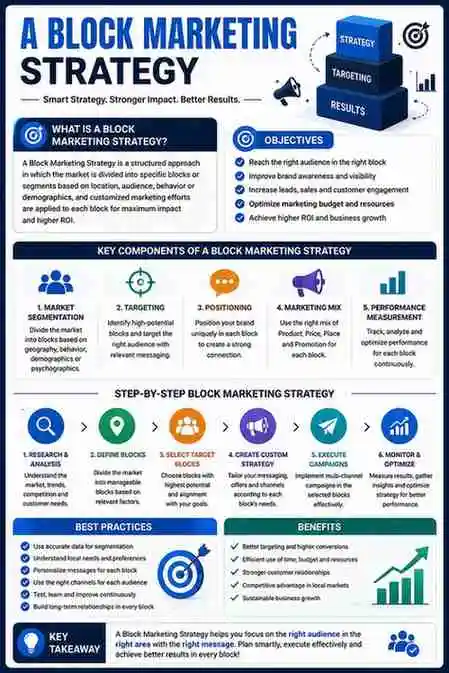
How a Block Marketing Strategy Works: 5 Steps to Follow
Step 1: Define Your Block
Your “block” does not have to be a literal city block. It is the geographic zone where your ideal customers live or spend time. A daycare centre might focus on a one-mile radius. A hardware store might cover three or four nearby neighbourhoods. The key is specificity.
Ask yourself: if I could only reach 500 households, which 500 would I choose?
Step 2: Understand the Community Before You Market to It
Before creating a single piece of content, spend time listening. What do residents care about? Are there local events, shared interests, or recurring issues you can speak to?
Attend a neighbourhood association meeting. Sponsor a school event. Show up at a farmers’ market. One afternoon of genuine community engagement teaches you more than weeks of demographic research.
Step 3: Choose Your Outreach Channels
Block marketing does not mean using only one channel. It means filtering every channel through a local lens. Common tactics include:
Door-to-door marketing. A well-designed flyer hand-delivered with a respectful knock gets noticed in ways a digital ad cannot replicate.
Residential area promotion. Lawn signs, community bulletin boards, local school newsletters, and neighbourhood Facebook groups are trusted channels within tight-knit communities.
Hyperlocal digital advertising. Platforms like Nextdoor, Google Local Service Ads, and neighbourhood-specific Instagram geotags let you run targeted neighbourhood advertising visible only to people in your defined area.
Local business partnerships. A dentist and a pediatric clinic can cross-promote without competing. A bookstore and a coffee shop are natural allies. These arrangements amplify your reach without increasing your budget.
Step 4: Create Community-Specific Content
Generic content gets scrolled past. Content that feels locally made gets shared. Reference yoneighbourhoodood. Mention local landmarks. Celebrate community events. Congratulate the local high school sports team. These small touches signal that you are not just a business passing through — you are part of the community.
Step 5: Measure What Actually Works
Give each channel its own tracking mechanism. A door-to-door campaign uses a unique coupon code. Your Nextdoor ad points to a specific landing page. A local partnership gets a mention code. This way, you know exactly where new customers come from and can invest more in what works.
Block Marketing Examples That Show Real Results
The Local Pizza Shop. A small pizza restaurant noticed a new housing development nearby. Instead of waiting for residents to discover them, they partnered with the developer to include a free appetiser offer in every new homeowner welcome packet. Within two months, they had captured a loyal base from the entire development.
The Independent Gym. A neighbourhood fitness studio ran a “Join With a Neighbour” campaign on Nextdoor. Members who brought a neighbour to a free class earned a discounted monthly rate for both. The referral mechanic, combined with a hyperlocal channel, created organic word of mouth that spread through surrounding blocks.
The Home Services Company. A plumbing company used door-to-door cards in areas where they had recently completed jobs. The card said: “We just worked on your neighbour’s home at [street address]. If you ever need us, we are already familiar with the pipes in this area.” That campaign outperformed their paid Google ads in local customer acquisition.
Block Marketing Benefits: Why This Outperforms Broad Advertising for Local Businesses. Sceptical about whether localised effort is worth it compared to digital campaigns that reach thousands at once? Here is the honest comparison.
Higher conversion rates. People who live near your business are far more likely to become regular customers. Proximity drives purchase decisions, especially for services and everyday products.
Lower cost per customer. A tightly defined audience means fewer wasted impressions. Location-based marketing means every dollar targets someone who could realistically walk through your door.
Stronger brand loyalty. Community engagement builds relationships, not just transactions. Customers who feel a personal connection to a local business return more often, spend more per visit, and refer more friends and family.
Word-of-mouth amplification. Neighbors talk. One satisfied customer in a tight-knit neighbourhood can influence ten to fifteen others through casual conversation alone.
Competitive advantage no budget can buy. National brands can outspend you on Google and Facebook. They cannot out-neighbour you. Your physical presence, community involvement, and local knowledge are advantages that advertising dollars cannot replicate.
The Most Effective Block Marketing Tactics for Small Businesses
These techniques work without a large team or sophisticated tools.
Geo-targeted social media posts. Facebook and Instagram let you display posts and ads only to users within a specific zip code or radius. This is one of the most accessible forms of hyperlocal advertising available to any budget.
Google Business Profile Optimisation. Fully optimise your listing with accurate hours, recent photos, and responses to every review. When someone nearby searches for what you offer, a well-maintained profile is your best chance at appearing first.
Local event sponsorship. Sponsor a Little League team, a community 5K, or a school fundraiser. Your logo on a banner seen by hundreds of local families delivers more value than an equivalent spend on a generic display ad.
Neighbourhood referral programs. Frame your referral incentives around neighbourhood connections. “Refer neighbour, or you both save” is more powerful than a generic offer because it activates the social trust that already exists between people who live near each other.
Community newsletter advertising. Many neighbourhoods have a local email newsletter or community paper reaching hundreds of engaged households. Advertising there is inexpensive and carries a level of trust that outside channels cannot match.
Seasonal door hangers and mailers. Targeted to specific streets or blocks, a well-timed seasonal offer delivered physically gets seen and remembered in ways that email rarely achieves.
When Block Marketing Can Backfire (What Nobody Tells You)
Most articles on hyperlocal marketing are written to sell the concept. Nobody wants to acknowledge the failure modes. But experienced practitioners who have run dozens of block campaigns know something the marketing blogs rarely admit: a block marketing strategy can actively hurt your local reputation if deployed in the wrong conditions or the wrong way.
Oversaturation of a small area. When a business hits the same 200 households with flyers, door hangers, Nextdoor ads, and community posts within the same 30-day window, residents do not feel marketed to — they feel harassed. The practical rule most experienced practitioners follow is no more than three touchpoints per household per month across all channels combined. Beyond that, you are paying to damage your own reputation.
A demographic mismatch with your target area. A premium service business targeting a price-sensitive residential area will generate inquiries it cannot convert. Block marketing amplifies your reach within a geographic zone. If area demographics do not align with your price point or offer type, you are simply amplifying the mismatch faster and more visibly.
Community backlash in close-knit neighbourhoods. Certain neighbourhoods have strong informal gatekeepers: active association presidents, long-tenured residents with deep social capital, or vocal Facebook group administrators. If your outreach is perceived as tone-deaf or disrespectful of existing community norms, one vocal resident can turn an entire neighbourhood against your brand within days. Research the community culture before you enter it.
Competitor counter-targeting. A visible block campaign signals to competitors exactly where your growth is happening. Sophisticated local competitors may respond by running their own campaigns in the same area with deeper discounts or stronger existing ties.
Targeting neighbourhoods in demographic or economic decline. High vacancy rates, a shrinking population, or pending municipal redevelopment mean your potential customer base is literally shrinking as you invest. Checking local census data and municipal planning documents before defining your target block takes two hours and can save months of wasted effort.
The honest question to ask before launching is not just “where are my best potential customers?” — it is “does this neighbourhood have the stability and community dynamics that will allow my campaign to build rather than backfire?”
Why Timing and Sequence Matter More Than Channel Selection
Almost no block marketing content addresses this: the order in which you deploy your tactics matters more than which tactics you choose. Deploying the wrong channel at the wrong stage of community awareness is one of the most common and least diagnosed reasons block campaigns underperform.
Lead with awareness, not offers. The most consistent mistake is leading with a discount before the community knows who you are. When residents receive a promotion from a business they have never heard of, the default reaction is scepticism, not excitement. Send at least one pure awareness touchpoint — something genuinely useful — before any offer-based message reaches the same household.
Run digital before physical in new territories. Counter-intuitively, running a low-budget Nextdoor or local Facebook awareness campaign two to three weeks before any physical door-to-door effort significantly improves the reception of that physical outreach. Residents who have seen your name online are far more likely to engage positively when a flyer arrives, because you are no longer a stranger.
Activate referral programs after the first wave of satisfied customers. Most businesses launch their referral program at the same time as their initial awareness campaign. This is backward. Referral mechanics work best when activated four to six weeks after the initial outreach, once a meaningful group of early customers has experienced your service and formed a positive opinion.
Anchor your launch to a community moment. The highest-performing block campaigns are sequenced around an existing local event — a block party, a school year start, a local festival, or a seasonal change. These give you a natural, non-commercial reason to be visible.
Plan a deliberate rest period. After the initial campaign burst, the smarter move is a planned 45 to 60-day quiet period followed by a re-engagement in a different format. The re-engagement, arriving after a pause, tends to convert better because it does not feel like pressure.
Think of block marketing sequencing less like a playlist you shuffle and more like a conversation. You introduce yourself, you listen, you offer something useful, you let the relationship breathe, and then you deepen it. Rushing any of those stages produces the same awkward result as it would in any real human interaction.
Common Block Marketing Myths That Are Wasting Local Business Budgets
| Common Belief | What Actually Happens |
|---|---|
| More flyers equals more customers | Volume without design quality and offer relevance produces near-zero results. One genuinely valuable flyer to 200 households outperforms 1,000 generic ones. Print volume is a vanity metric. Offer quality is what converts. |
| Nextdoor is the only hyperlocal digital channel. | For many demographics, neighbourhood Facebook groups, local subreddits, and school communication platforms reach more active residents than Nextdoor. Channel selection should follow where your specific community actually spends time. |
| Block marketing only works for storefront businesses | Service-area businesses — plumbers, tutors, cleaners, mobile groomers — often see higher ROI than storefront businesses because the service comes to the customer. Service area overlap is what matters, not physical location. |
| Good work generates automatic word of mouth. | Satisfied customers simply do not think to mention a business to their neighbours unless specifically prompted. Referral mechanics, follow-up cards, and direct asks are what actually convert satisfaction into referrals. Passive word of mouth is largely a myth. |
| Block marketing is cheaper than digital advertising | When you factor in design, printing, distribution labour, and community engagement time, block marketing is often more expensive per impression than digital. It converts better — but it is not a budget shortcut. Underinvesting in execution because you expect it to be cheap is one of the most reliable ways to get poor results. |
What to Set Up Before You Launch a Single Flyer
The campaign itself is rarely what determines success or failure. What determines success is the conversion infrastructure that campaign traffic encounters once it is generated.
Optimise your Google Business Profile before day one. When a block campaign creates awareness, the first thing most residents do is search your business name on Google. If your profile has incomplete hours, no recent photos, or unresponded reviews, the campaign traffic converts at a fraction of its potential. This is the single highest-leverage pre-campaign task and the one most businesses skip.
Establish a local phone number with a committed response window. Block campaigns in residential areas frequently generate phone calls, particularly from older demographics. If those calls go to voicemail and are not returned within two to four hours, the conversion opportunity is almost certainly gone.
Build review velocity before the campaign goes live. Ten recent reviews beat fifty old ones. Run a deliberate review-generation effort with your existing customers so that when new neighbourhood residents search for you, they find current and credible social proof waiting for them.
Set up community listening before you enter the neighbourhood. Monitor the relevant local Facebook group and Nextdoor community passively for two to three weeks before launching. This gives you a baseline understanding of community sentiment, any competitors already active in the space, and any local sensitivities you should be aware of.
Build a simple inquiry follow-up system. Block campaigns generate uneven spikes in inquiries. Track every inquiry by contact date, source channel, follow-up date, and conversion outcome. This data tells you which channels and which neighbourhoods are producing your best customers.
Setting up this infrastructure before launch is unglamorous work. But it is the difference between a campaign that generates awareness and a campaign that generates customers.
How to Scale Block Marketing Without Losing What Makes It Work
These insights are for businesses that have already run a successful block campaign and want to replicate results across multiple neighbourhoods.
Use your first successful block as a credibility asset in adjacent territories. The most effective expansion pattern is not running identical campaigns in multiple new areas at once. Dominate one block completely, then use the social proof generated there as a persuasion tool when entering the next. A testimonial from “yourneighbourr on [street name]” carries far more weight in an adjacent neighbourhood than any copy you can write.
Map your territories by maturity stage, not just by geography. Different neighbourhoods require fundamentally different investment levels. A territory where you have operated consistently for 18 months needs maintenance-level activity to retain loyalty — not the same intensity as a new acquisition target.
| Territory Stage | Primary Goal | Investment Level | Key Tactics |
|---|---|---|---|
| New Acquisition | Build initial awareness | High | Awareness content, digital priming, physical outreach |
| Active Development | Convert and deepen relationships | High to medium | Referral programs, event presence, and community engagement |
| Established Loyalty | Retain and expand referrals | Medium | Review generation, seasonal offers, and re-engagement campaigns |
| Passive Maintenance | Stay present and prevent churn | Low | Periodic mailers, social mentions, review responses |
Preserve local voice at scale. What makes block marketing feel genuine at a single-location level starts to feel manufactured when replicated across ten neighbourhoods with templated content. The critical discipline is maintaining locally distinct messaging — different community references, different landmarks, different seasonal hooks for each territory.
Know when to stop expanding and consolidate. Over-extension kills local reputation faster than any competitor can. Watch for warning signals: average inquiry response time increasing beyond four hours, review response rate falling below 80 per cent, or repeat customer rate in established territories beginning to decline. Any of these signals means expansion should pause until your operational foundation catches up.
Frequently Asked Questions About Block Marketing
What is the difference between block marketing and traditional local advertising?
Traditional local advertising covers a broad geographic area — an entire city or region — through channels like radio, newspapers, or citywide digital ads. Block marketing narrows the focus dramatically to a specific neighbourhood or community district. The result is higher relevance, lower cost per acquisition, and stronger relationship building with the people most likely to become repeat customers.
Is block marketing only suitable for certain types of businesses?
It works especially well for businesses that depend on local foot traffic or repeat community customers: restaurants, gyms, salons, home services, daycares, dental offices, pharmacies, and retail shops. Any business with a defined service area can also benefit. Even online businesses with a strong local component — such as local delivery services, neighbourhood tutoring platforms — have seen strong results.
How much does a block marketing campaign typically cost?
Door-to-door flyer campaigns can cost as little as a few hundred dollars in printing and time. Nextdoor ads, geo-targeted social posts, and local event sponsorships can range from a few hundred to a few thousand dollars per month. Working with a professional agency increases cost but also tends to increase effectiveness and ROI significantly.
How long does it take to see results?
You can often see initial results — new inquiries, coupon redemptions, or foot traffic increases — within the first two to four weeks. Deeper results like sustainable neighbourhood loyalty, strong referral rates, and community recognition typically develop over three to six months of consistent effort. The returns compound over time in ways that broad advertising rarely does.
How do I measure the success of a block marketing campaign?
Use trackable elements: unique coupon codes per channel, custom landing page URLs for each outreach type, and ask new customers directly how they heard about you. Track metrics like new customer acquisition rate, repeat visit frequency, local review volume, and referral rates from your target geographic area.
Conclusion: Why Block Marketing Is One of the Most Underrated Growth Strategies for Small Businesses
Block marketing works because it is built on a fundamental truth: people prefer to do business with brands they know, trust, and feel connected to. When your marketing is woven into the fabric of a community, you stop being a business and start being a neighbour. That shift changes everything.
Whether you are running your own campaigns or working with professionals like A Block Marketing Inc in Lemont, IL, the principles remain the same. Define your area. Understand your community. Show up consistently. Lead with value. Never underestimate the power of one well-placed, genuinely helpful interaction within the neighbourhood you serve.
The businesses that master local customer acquisition at the block level build lasting, resilient customer bases that no algorithm change, no competitor, and no economic shift can easily take away.
Start small. Stay consistent. Go deep before you go wide. That is the block marketing mindset — and it works.
LINKS:- Digital Marketing New Britain, CT: Best Local Growth Guide
