
Is Carson Knutson Marketing Agency the Right Fit for You?
Searching for Carson Knutson marketing agency services usually means you want one simple answer: is this a real agency, what do they actually do, and is it worth a phone call?
Fair question. Hiring a marketing agency isn’t like buying shoes. You can’t return it in 30 days if it doesn’t fit.
So before you fill out a contact form, let’s break down what to expect, what to verify, and how to judge fit for your own business — without the usual buzzword fog.
I’ve spent years helping small business owners make sense of the agency world. Here’s the truth: most agency websites sound identical. Vague promises, stock photos of people pointing at laptops, the works. This guide skips that. Below, you’ll find what marketing agency services actually look like in practice, the kind of work an agency like Carson Knutson’s typically offers, and how to make a confident decision either way.
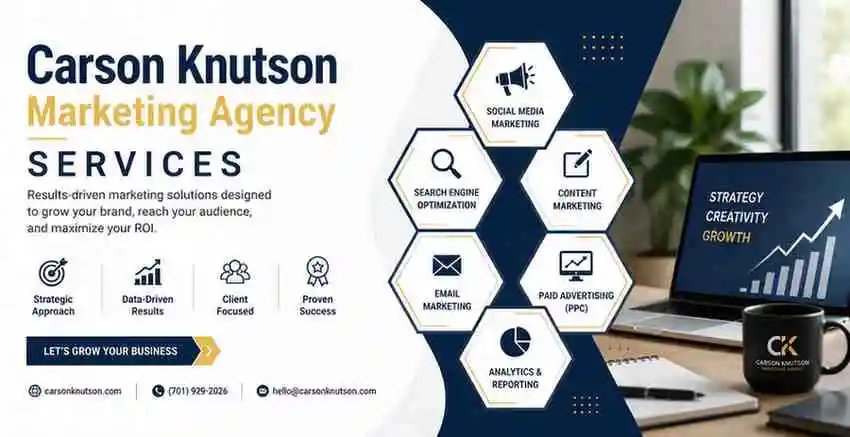
What Does Carson Knutson Marketing Agency Offer?
Like most growth-focused agencies, Carson Knutson’s work likely centres on a few core areas of digital marketing rather than trying to cover everything at once. While exact service details should always be confirmed directly with the agency, here’s the kind of breakdown a real services page should include:
- Paid advertising management. Running and optimising ad campaigns across Meta, Google, or TikTok, with a focus on return on ad spend rather than just clicks.
- Client strategy and account management. Acting as the main point of contact, translating data into plain language, and keeping campaigns aligned with revenue goals.
- Analytics and reporting. Turning raw numbers into a story that a business owner can actually use to make decisions.
- Campaign optimization. Testing creative, audiences, and budgets to find what consistently performs.
To be straightforward: the exact service list, pricing, and client results can vary by agency and are best confirmed directly — through an official website, a direct conversation, or a verified business listing. If you’re close to hiring, ask directly. Any legitimate agency will walk you through its process before you sign anything.
links:- https://www.backendbranding.com/
Why This Matters: A Real Client Story
A few years ago, I helped a friend who ran a small skincare brand find the right marketing partner. She’d already been burned once — paid a few thousand dollars upfront, got a generic strategy document, then watched her ad account underperform for two months with no real explanation. When she finally got a call, she heard vague answers about “algorithms” and “patience.”
The second agency she tried did something different. Before charging anything, they asked about her actual numbers: average order value, current spend, and what had worked informally in the past. They explained their process in plain English, not jargon.
That’s the real difference between an agency selling a service and one solving a problem. Whether you’re evaluating Carson Knutson’s advertising services or any other provider, the questions you ask before hiring matter more than the logo on the website.
The 7 Types of Digital Marketing Services (And Where Agencies Like This Fit In)
This is one of the most common questions people ask once they start researching agencies. Most digital marketing agencies — including those offering Carson Knutson digital marketing solutions — build their service menu from some combination of these seven categories:
- SEO (search engine optimisation). Improving a website so it ranks higher in organic search over time.
- PPC (pay-per-click advertising). Paid ads on platforms like Google Ads are billed per click or impression.
- Social media marketing. Building brand presence and running campaigns on Instagram, Facebook, TikTok, and LinkedIn.
- Content marketing. Blog posts, videos, and guides that attract and educate an audience.
- Email marketing. Nurturing leads and customers through owned communication channels.
- Affiliate and influencer marketing. Partnering with creators or websites to extend reach.
- Branding and creative services. Logo design, messaging, visual identity, and brand feel.
Most agencies don’t go deep on all seven. A smaller, specialised shop usually focuses on two or three and does them well, rather than spreading thin. If you’re researching Carson Knutson marketing agency services, ask directly which categories they specialise in — and which ones they outsource or skip.
What a Digital Marketing Agency Actually Does Day-to-Day
Beyond the seven broad categories, here’s what a real working relationship with an agency tends to look like once you’re past the sales pitch.
Discovery and strategy. Most engagements start with an audit of current marketing, competitors, and goals before any recommendations are made.
Campaign setup and management. Setting up ad accounts, writing copy, designing creative, and launching campaigns.
Ongoing optimization. Marketing isn’t “set it and forget it.” Good agencies adjust budgets, test new creative, and refine targeting on a regular cadence.
Reporting and communication. Expect regular updates, ideally in a language you can understand without a marketing degree.
Consulting and strategy sessions. Some agencies, including those offering Carson Knutson marketing consulting, build in regular strategy calls rather than just running campaigns quietly in the background.
If an agency can’t clearly explain which of these they provide — and how often you’ll hear from them — that’s worth noting before you commit.
What Really Happens in Your First 45–60 Days With an Agency
Most articles treat “discovery and strategy” as a single bullet point. In reality, the first two months are operationally messy — and frequently misread by clients. Understanding this window is one of the biggest predictors of whether the relationship survives long enough to actually work.
Weeks 1–2: Access and infrastructure, not strategy. Most of this time goes into things you never see — requesting ad account access, auditing existing tracking, untangling whatever the last agency left behind. Delays here are usually caused by the client’s own IT or billing admin, not agency incompetence.
Weeks 3–4: Tracking calibration and the “bad data” period. Even with a clean setup, tracking (pixels, GA4, server-side tagging) typically takes two to four weeks to stabilise. Reported numbers during this window are often misleadingly low. This is the most common point where clients panic and assume the agency is failing — when really, the data itself isn’t trustworthy yet.
Weeks 5–8: Early testing and the expected dip. Most accounts see performance dip below the previous baseline here, because the agency is testing new audiences and creative rather than just running what already worked. A dip isn’t automatically a red flag — it’s usually just what testing looks like.
What a legitimate Day-30 deliverable looks like. A documented audit, a clear account architecture, and a written testing roadmap for the next 30 days. Vague reassurance without anything in writing is reasonable to push back on.
The “honeymoon cancel” pattern. A surprising number of relationships end in month one or two — right as data starts stabilising — because the client panics at normal early volatility and churns before seeing any real signal. Recognising this pattern in advance is one of the most useful things a prospective client can do.
| Timeframe | What’s Actually Happening | What Clients Often Assume |
|---|---|---|
| Weeks 1–2 | Access requests, account audits, tracking review | “Why hasn’t anything launched yet?” |
| Weeks 3–4 | Pixel/tracking calibration, unstable data | “The numbers look bad — this isn’t working” |
| Weeks 5–8 | Intentional testing, possible dip below baseline | “Performance got worse since we hired them” |
| Day 30 | Audit + architecture + roadmap should exist in writing | “They keep saying trust the process” |
Myth vs. Reality: What Marketing Agencies Actually Do Behind the Scenes
Most myth-busting content in this space is surface-level: “Myth: agencies guarantee results. Reality: nobody can guarantee results.” True, but not useful. Here’s what actually costs business owners money and patience.
| Common Belief | What’s Actually True |
|---|---|
| Bigger budget = proportionally bigger results | Most accounts hit a saturation ceiling; returns flatten or drop once an audience is exhausted. |
| Agencies fully control algorithm performance | Platform volatility (especially Meta’s) is partly outside anyone’s control |
| More check-ins = better service | Less reactive tinkering often performs better early on |
| “It depends” on pricing/timeline = evasive | Often, more honest than a firm quote given blindly, before reviewing your data |
| Switching agencies often = faster improvement | Resets the 60–90 day signal clock every time, usually making results worse |
A closer look at the most damaging one: switching agencies frequently to find a “better” fit. Most ad accounts need 60 to 90 days of continuity to generate a clean, usable signal. Every switch resets that clock. Frequent agency-hopping is one of the most common, self-inflicted causes of mediocre long-term performance.
What Is Modern Marketing? (And Why It Changes What a Good Agency Does)
Modern marketing is less about interruption and more about relevance. Older models focused on broadcasting a message to as many people as possible. Modern marketing focuses on reaching the right person, at the right time, with a message that actually matters to them.
This shift changes what a good agency does day to day:
- It leans heavily on real customer behaviour data, not guesses
- It treats content as something that should genuinely help or entertain, not just sell
- It measures success by revenue and retention, not vanity metrics like impressions
This is also where a structured framework — like Mark Ritson’s approach to marketing — becomes useful context.
The Mark Ritson Marketing Framework: 6 Steps to Evaluate Any Agency
Mark Ritson is a well-known marketing professor and consultant who has written extensively about bringing structure and discipline back into marketing strategy. His approach is a useful lens for evaluating any agency, including one offering Carson Knutson business growth strategies.
- Set clear objectives. What does success actually look like, in specific, measurable terms?
- Define the target market. Who exactly are you trying to reach — described with real specificity, not “everyone”?
- Position the brand. What makes this business different, and why should the target customer care?
- Build the marketing mix. Product, price, place, and promotion work together rather than in isolation.
- Execute with discipline. Stick to the strategy rather than chasing every new trend or platform.
- Measure and adjust. Track results against the original objectives, not just whatever metric looks good that month.
When talking to any marketing agency — including Carson Knutson’s team — ask whether they follow a structured process like this, or jump straight into tactics without a strategic foundation.
Attribution Drift: Why Two Agencies Can Report Different Numbers for the Same Campaign
This is genuine insider knowledge most consumer-facing articles never touch. Most people assume reporting is objective — the campaign either performed well or it didn’t. In reality, the same underlying performance can be reported very differently depending entirely on how attribution is configured, with zero change to actual results.
- Platform-reported vs. verified revenue. What Meta or Google’s dashboard reports as revenue can differ from what actually shows up in Shopify or your bank account — often by 20 to 40 per cent.
- Lookback windows change the story. A 1-day, 7-day, or 28-day click attribution window produces meaningfully different numbers for identical performance.
- Last-click attribution undervalues upper-funnel work. Content and brand-building campaigns often get little credit, even when they’re doing real work earlier in the customer journey.
- The incrementality question. A meaningful share of “attributed” revenue would often have happened anyway — particularly for branded search or retargeting people already planning to buy.
| Attribution Method | What It Measures | Common Distortion |
|---|---|---|
| Platform-reported (Meta/Google) | Conversions, the platform believes its ads caused | Often 20–40% higher than verified revenue |
| 1-day click window | Conversions within 24 hours of a click | Understates longer decision cycles |
| 28-day click window | Conversions within 28 days of a click | Can overstate impact, crediting unrelated purchases |
| Last-click attribution | Credit to the final touchpoint | Undervalues upper-funnel content/awareness work |
One question to ask in your first reporting call: “Is this platform-attributed or revenue-verified, and what attribution window are we using?” Asking this early signals you understand reporting isn’t automatically objective — and it tends to improve the quality of every conversation that follows.
How to Evaluate Carson Knutson Marketing Agency Services Before You Hire
A practical checklist for separating a good agency relationship from a frustrating one:
- Ask for specifics, not promises. A real agency should explain exactly what they’ll do in the first 30 days.
- Ask about reporting. How often will you get updates, and in what format?
- Ask about past results. Case studies or references are reasonable to request.
- Clarify pricing structure. Flat fee, percentage of ad spend, or retainer — each has tradeoffs.
- Check communication style. Do they explain things clearly, or lean on jargon?
This applies whether you’re looking at Carson Knutson SEO services, content marketing, social media management, or any other specific offering. The category matters less than the clarity and honesty of the answers you get.
When the Standard Red-Flag Checklist Gets It Backwards
Every agency-hiring article includes the same generic warning list: no case studies, vague pricing, no contracts, slow responses. What almost none of them mention is that these signals mean different things depending on context — and following the generic checklist can actually steer you toward a worse decision.
| Signal | Common Interpretation | When It’s Actually Fine | When It’s Actually a Problem |
|---|---|---|---|
| No case studies | “They’re hiding bad results” | New or founder-led agency, early stage | Established agency refusing to share any results |
| No minimum retainer | “They’re flexible and client-friendly” | Boutique shop, low client volume | High-volume agency too stretched to say no |
| Very fast sales response | “They’re attentive and reliable” | Small team genuinely available | An overextended team overpromises to win the deal |
| Month-to-month contract | “Low risk, easy to leave” | Genuine trial period | Account quietly deprioritised due to instability |
| Custom-quote-only pricing | “They’re hiding costs” | Real scoping based on complexity | Vague pricing obscuring markup |
Founder-Led Agency vs. Large Firm: Which Should You Choose?
Many searches like this one are about a specific person rather than a faceless firm, so it’s worth addressing directly.
Potential advantages of a founder-led agency:
- Closer, more direct communication — often with the founder themselves
- More flexibility in how services are packaged
- Personal accountability, since their name and reputation are tied to the work
Potential tradeoffs:
- Smaller team capacity compared to a large agency
- Less likely to have every speciality in-house
- Bandwidth can be limited if they take on too many clients at once
Neither model is automatically better. It depends on what your business actually needs right now.
Advanced: Scaling Past Your First Win (Why $50/Day Campaigns Often Break at $500/Day)
This section assumes you already understand the basics and are past the “test and optimise” stage. Scaling a working campaign is a different skill from finding the initial win, and most costly mistakes happen at the scaling stage, not the launch stage.
- Audience saturation. A campaign that converts well at low spend often shows rising CPMs and falling ROAS as budget increases, because the algorithm reaches into colder, less-qualified audience segments.
- Creative fatigue accelerates at scale. A creative that took six weeks to fatigue at $50/day might fatigue in six days at $500/day, since far more impressions are needed to spend the larger budget.
- Vertical vs. horizontal scaling. Increasing the budget on an existing campaign is vertical scaling. Duplicating success into new audiences or platforms is horizontal scaling — the preferred move past a certain budget threshold.
- The 20% rule. Increasing the budget by more than ~20% every few days tends to reset the platform’s learning phase, temporarily tanking performance.
- Scaling is a creative production problem. Sustained scaling requires a constant supply of new creatives. If an agency’s scaling plan is only “increase the budget,” the deeper mechanics aren’t being accounted for.
| Vertical Scaling | Horizontal Scaling | |
|---|---|---|
| What it means | Increasing the budget on an existing campaign | Duplicating success into new audiences/platforms |
| Best used when | Early scaling, smaller increases | After hitting a saturation ceiling |
| Main risk | Resets the learning phase if too fast | Requires more creativity and management overhead |
| Rule of thumb | ~20% increase every few days | Expand once an existing segment shows saturation |
Expert note: If performance drops after a budget increase, the first question isn’t “what went wrong” — it’s “how much did the budget increase, and how fast.” The answer is usually in the math, not the strategy.
Frequently Asked Questions
What does Carson Knutson Marketing Agency offer? Like most agencies in this space, the focus is likely on a specific niche — such as paid advertising or account management — rather than every marketing service available. It’s best to confirm the exact scope directly.
Is Carson Knutson Marketing Agency a good fit for small businesses?
That depends on your specific goals, budget, and the agency’s stated focus area. Ask directly about minimum budgets and ideal client profiles before starting.
How much do Carson Knutson marketing agency services cost?
Pricing varies by agency and service type, and is typically provided after an initial consultation based on your specific needs.
What industries does Carson Knutson typically work with?
This varies by agency speciality — some focus on e-commerce, others on local service businesses or other niches. It’s worth asking directly which industries they have the most experience with.
How do I get started with Carson Knutson marketing agency services?
Most agencies begin with an initial consultation call to understand your goals before proposing a strategy. Reach out through an official contact form or verified business page as the safest first step.
Final Thoughts
If you’re researching Carson Knutson marketing agency services, the goal here was a clear, honest framework for evaluating that decision — not another page of generic promises. A trustworthy agency, whether this one or any other, should explain its process, show real results, and communicate in plain language.
The businesses that end up happiest with their agency are the ones that ask direct questions early, rather than assuming a polished website tells the whole story. Take the time to verify, ask for specifics, and trust your own judgment about how clearly someone explains their work. That single habit will serve you better than any list of services ever could.
relative:- A Block Marketing Strategy: The Complete Guide to Hyperlocal
